

Jessie Tracy has been working in B2B tech for over 20 years, advocating for the craft of creative that can drive accountable performance excellence and was the previous CEO of the marketing agency Velocity Partners. She's evangelical that the best results come from a true client and agency partnership.
View Jessie Tracy’s postsPublished in:
15 mins read
Vertical marketing strategy in B2B: when, why and how
Vertical content often out-performs generic content by a lot. Here's when it's worth the trouble, and how to try it without making 19 versions of everything.
Vertical marketing is creating or reshaping your marketing for buyers in one specific industry, so a bank gets a story about banks.
If there’s one question that strikes terror in the hearts of most B2B marketers, it’s this one:
“Hey, why don’t we try some vertical content?”
I’ve seen it dozens of times (often because I was the one asking the question). Just about every B2B marketer understands the power of targeting vertical industries. But very few want to do it in earnest.
This post will explore the what, when, why and how of vertical content marketing (and vertical marketing in general) and why I think it’s underused and over-feared. My goal is simple: to help you get over yourself and give it a try (if you haven’t) or to get serious about it (if you’ve just started) or to feel great about yourself if you’re killing it (keep up the good work).
Let’s do this.
What is vertical marketing?
Um, it’s creating or re-shaping content to address buyers in a specific vertical market.
Vertical marketing is one of the first steps toward one of the most powerful tactics in B2B marketing: segmenting your audience into chunks so you can market to them differently.
Vertical chunks may be the first real segmentation any B2B marketing team does. (The only more fundamental segmentation is probably “customer/non-customer”).
As such, it’s also the first step toward that mythical thing called Personalization (fetishized in breathless phrases like, “True one-to-one marketing”).
While personalization can be kind of hard to get your head (okay, my head) around (involving icky things like data and martech and integration), segmenting your audience by industry and targeting each with specific content is easy to understand and not that hard to do (though scaling can be a beast, as we’ll see).
Vertical marketing is also the shallow end of the Account Based Marketing pool. Even if you’re not yet ready to dedicate resources to a few named accounts, you can still target priority industries. It’s a good place to start what my imaginary friend Pesky calls “Your ABM journey”. (Pesky has few other friends).
That’s what vertical marketing is. Now the why.
But what’s an industry?
Should be obvious, right? Some industries are clearly industries (like banking). But what about retail? That can be both a vertical industry and a discipline within another industry (the retail arm of a bank).
Sometimes so-called ‘vertical’ programs are really targeting a persona or line of business (HR, Accounting). But sometimes these lines of business kind of act like vertical markets—with their own problems and challenges and jargon.
For this piece, let’s use ‘vertical’ for mostly discrete industries (with their own SIC codes). But the same thinking can be adapted to work for any segment you want to treat separately.
Is vertical marketing the same as a vertical marketing system?
No. A vertical marketing system (VMS) is a distribution term, and it has nothing to do with targeting an industry. In a VMS, the firms along a sales channel coordinate their planning and activity as one system, through shared ownership (a corporate VMS), a contract (a contractual VMS) or informal agreements (an administered VMS). McDonald’s and its franchisees are the usual example. If that’s what you came for, this open textbook chapter on channel types will serve you better. Everything below is about the other meaning.
Why do vertical marketing?
You already know the answer in your gut even if it’s not yet reflected in your strategy:
Vertical marketing increases the resonance and credibility of your content. And content with lots of these two things out-performs content with less of them.
Say you’re a procurement professional in the supply chain industry. (Just say it, for heaven’s sake and we can get on with this). In your efforts to find a new, um, Cloud Purchase Helper Suite, you visit the websites of two likely vendors.
Vendor A, Procuriatata, has a Resource Library swollen with come-hither content sporting titles like, “The Six Essentials of Cloud Purchase Helper Suites” and “Why Cloud Purchase Helper Suites Will Help Drive Down the Cost of Yadda-Yadda-Yadda”.
In refreshing contrast, Vendor B, ProcProMax, offers stuff like, “The Role of CPHSs in Supply Chain and Logistics” and “How CPHSs help Supply Chain Procurement Professionals Procure Things In Such A Way That They Bloody well Stay Procured”.
Feel the difference?
Vertical content makes people from that industry lean forward because it sends these important signals:
Those are some KILLER signals to send, aren’t they?
It’s hard to argue against the logic: vertical content is more likely to resonate and build credibility with buyers in that market. So it’s more likely to do the things you really need content to help you do: like engage and educate and convert.
But logic alone is not enough to convince today’s data-addicted marketers. So you’ll definitely want to test for yourself. When we’ve done so with clients, vertical content invariably out-performs generic (to the degree you can remove other variables — not so simple in this case).
Here’s a pretty chart from a 2019 deck:
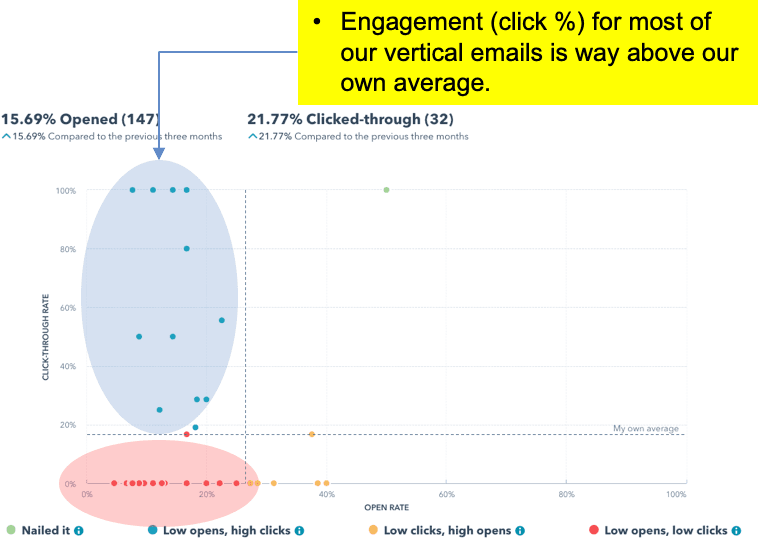
Vertical content for this client killed it on engagement metrics like click-throughs. (Needs work on our subject lines though).
Why does vertical marketing matter more in 2026?
Vertical marketing matters more in 2026 because even the most horizontal products in the world have started doing it. Anthropic launched Claude for Financial Services in July 2025, Claude for Life Sciences that October and Claude for Healthcare in January 2026. OpenAI launched OpenAI for Healthcare the same month. If companies whose product can do nearly anything have decided “anything” is a hard sell to a hospital, your general-purpose white paper has a problem.
Specialists are also arriving with money. Menlo Ventures estimates that vertical AI products took in $3.5 billion in 2025, nearly three times the $1.2 billion of 2024. (That’s a market model built with a November 2025 survey of 495 US enterprise AI decision-makers, from a venture firm that invests in the category.)
AI search raises the stakes again. Google says AI Overviews and AI Mode may use a “query fan-out” technique, issuing multiple related searches across subtopics to build a response. Our reading is that a question like “best procurement software for logistics firms” gets split into sub-searches where industry language matters, so a page that names the sector, its regulations and its vocabulary gives the system something to find. That’s inference, since Google doesn’t publish its sub-queries.
Why to avoid vertical marketing?
As compelling as they are, the reasons to do vertical marketing inevitably smack into the brick wall of “maybe next year”.
Because vertical marketing is a pain in the neck:
Those are some significant downsides, particularly for a small, overworked marketing team that’s being asked to do way more than last year with no more budget (a.k.a. every marketing team).
When to do vertical content marketing
Whether to do vertical content is one question. When to do it is another. It might be a really good idea but not yet a priority. Here are some things to consider when deciding if the time is right:
Do you really need to do vertical content?
No, you probably don’t need to.
And if you’re in a market with little or no perceived variability by industry, it may never be a priority.
If you’re selling staplers, your product is used pretty much identically in every industry. “Stapling In Banking” may not have any extra resonance to the office manager in a bank. (I’d argue you can still make a case for vertical marketing in low-variability markets—but it may not win budget from other things you could be doing—like that “Will It Staple?” video series.)
The key variable here is ‘perceived specialness’. If people in a market think that the challenges relating to your solution are unique to their industry, then you need to account for that.
If you’re marketing your staplers to the offshore oil industry, you might need to highlight the ‘spark-free stapling’ feature or promote ‘It floats!’ in the message stack. Yes, you can do that in general content. It depends how important offshore oil is to your sales forecast. I’m guessing not so much.
But if you’re marketing Process Re-Engineering software, then you’re in a highly industry-variable world. Processes in banking are completely different from processes in food service. So you may fail to get any traction at all unless you go vertical. That’s extra true when the inherent industry variability creates industry-specific competitors (whose marketing is 100% vertical)—but it applies even if not.
Kessler’s First Rule of Thermo-Verticality: The more different the markets you sell into are (as related to your solution area), the more vertical marketing will out-perform general content.
Can’t we all learn from each other?
Do we have to spoon feed everyone? Can’t a bank learn from a retailer and a vice learn from a versa?
Of course they can. And we all do this all the time. But sending general content to a vertical industry buyer is asking them to do the work of translation: to figure out exactly how this story applies to their world.
When you go vertical, you’re doing some of that work for them. Which reduces what our friends at PathFactory call “buying friction”. And less friction means faster sales cycles.
How to do vertical marketing
K. So you’ve decided to give it a go. Where do you start? You can’t just make 19 versions of every single thing you produce (if you can…. do that).
Instead, you need to decide on two things:
Let’s take the second one, because we’re rebels.
A verticalization spectrum
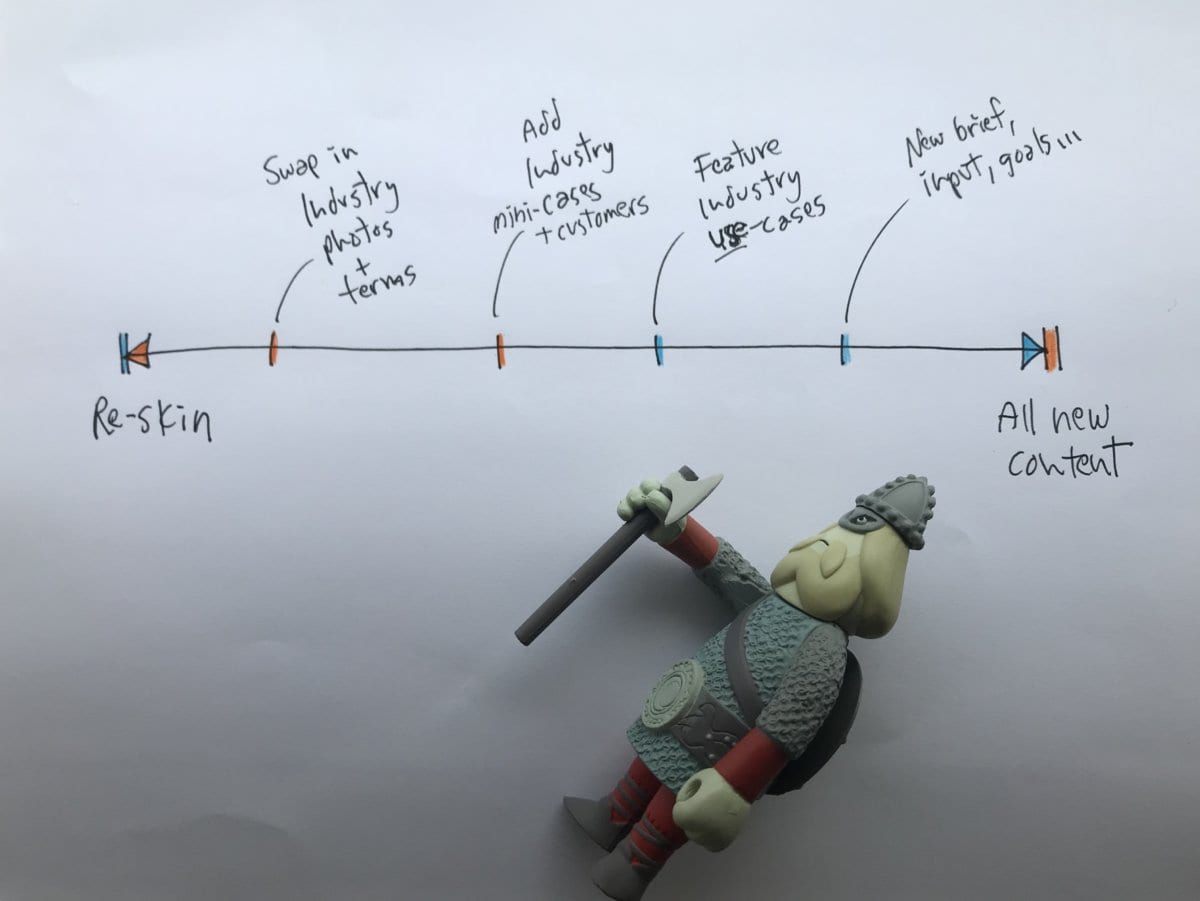
As Asgård indicates with his axe-pointer, vertical-specific content falls somewhere on a spectrum, from superficial re-skinning (change the cover… tweak the title…) to a completely new piece made only for this specific market.
The left side of the spectrum is more scalable and re-usable but won’t have as much impact. The right side is more powerful but is slower and more expensive and less re-usable in other markets.
Where you decide to aim on the spectrum will depend on a range of factors, including strategic ones (How important is this vertical?), tactical ones (How will we reach this audience?) practical ones (How much time and money do we have?), and political ones (Who’s asking for this anyway?).
The elements of verticalization
What elements make a piece of content vertical? Any or all of these, in increasing order of depth (more or less):
I put the language point near the bottom—the second most profound—but maybe it’s a bit more in the shallows. Not sure. It’s important though.
If you’re taking the “versioning” approach, you just need to replace the elements on this list that are from outside the industry with ones from inside. As many as you practically can. (Leaving in a data point from banking may still be okay in a retail piece. Not ideal, but it still may serve the purpose if an industry equivalent can’t be found.)
And if you’re taking the “all new content” approach, the whole shebang will be soaked in verticality from the brief to the call-to-action. (Super-relevant, not-so-scalable).
A warning about superficiality
If all of your vertical content is at the far left end of the verticalization spectrum, you might get uplift on some key metrics, but you’re probably also leaving some extra resonance-mojo on the table.
A bit of thought about the actual story itself and how to map it to this new market will pay dividends. (You lazy so-and-so).
How to choose the markets to target
Deciding to try a vertical approach doesn’t mean everything you do from now on must be spun into umpteen versions for every possible market.
You want to start with one or two markets most likely to deliver a return on the effort (RoE?). To do that, throw these factors into a hat and shake:
An industry isn’t a buyer, either. Inside every vertical there’s a buying group, and its members want different things. Pretzl’s 2026 Buyer Group Index, with the ANA and NewtonX, surveyed 200 senior go-to-market leaders and ranked persona messaging, tailoring messages to each role in the group, third most important of 28 practices, while respondents scored it only medium for performance. Our look at electronics buying groups shows what that means in one sector: a design engineer worries about thermal margins, and a buyer worries about line-down risk.
Four vertical audits to help shape your strategy
Before you launch a vertical marketing strategy, you’ll want to get the lay of the land; to gather all the data you can from a variety of sources, to shape your decisions. Four quick audits will help:
This data is all readily available and easy to harvest. Doing these quick audits will arm you with valuable insights that will help you:
Yes, you can make decisions like this without the input from the four audits. But… why would you?
Start small
Getting going with vertical marketing doesn’t demand tons of content from Day One. Start with blog posts or email. Add social media or paid social. Try PPC. When you start to see traction, ramp up to simple content, then honking big content, then whole, integrated programs.
And here’s a way to build a mini-lab for vertical stories:
A cool way to test for vertical resonance
Starting to experiment with vertical marketing doesn’t mean you have to produce any vertical content at all—just a few landing pages and promotions.
One tactic we love is to build a testing machine from a series of landing pages, all linking to a single piece of general, horizontal content.
The job of each landing page is simple: to tell a vertical industry story to prospects and to build a bridge to the piece of horizontal content—by showing how that content is indeed relevant to this industry.
It looks kinda like this:
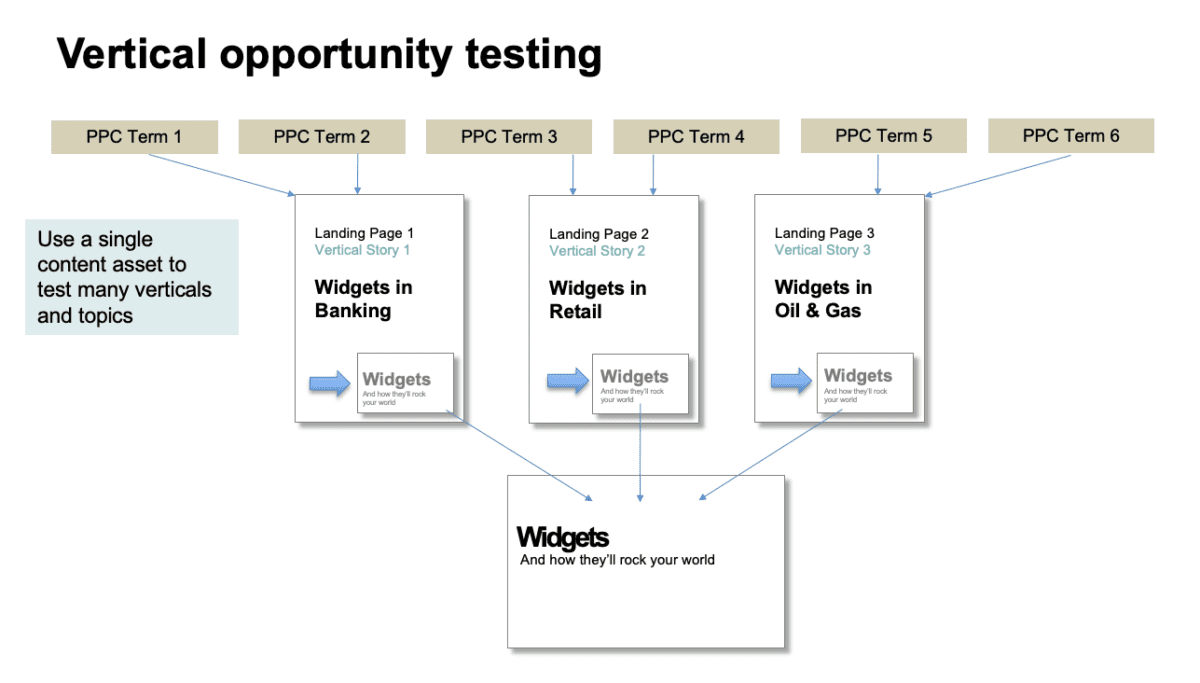
How to test vertical content without actually making any vertical content.
So you might buy some vertical Google Ads—or do social media or paid social or whatever—then send that traffic to these vertical ‘bridging’ pages (one per industry). And see how they do.
If you get a lot of uptake from an industry… go big, with real, chunky, vertical content. (No this isn’t tricking your audience: it’s simply showing them why this horizontal content is relevant to their market. Because it is.)
Distribution and merchandising vertical content
So how will this great vertical content find its audience? Like this:
All of these can really help you zero-in on members of a specific market, so you can laser them some vertical content without spilling over into other audiences.
The trade press is the channel most horizontal teams forget. In an April 2026 survey of 856 decision-makers across nine industries, Australian publisher Prime Creative Media found trade media was the most trusted source of information, and 57% used it to learn from case studies. It’s a trade publisher surveying its own readers, so pinch of salt.
Vertical channels plus vertical content is a great combination.
So what have we learned today. Anyone? Anyone?
I don’t know about you but I learned that:
Got any verticalization insight to add? So add!
Pretzl’s sector specialists can help you choose your first vertical, and then do the chunky part.
Common questions
What is vertical marketing?
Vertical marketing is marketing built for one specific industry, with messages, content and channels designed around how that industry works. A cybersecurity vendor running a program just for hospitals is doing vertical marketing. In distribution textbooks, the similar term “vertical marketing system” means something else: firms along a sales channel coordinating as one.
What is the difference between vertical and horizontal marketing?
Vertical marketing targets one industry, and horizontal marketing targets a role or need across many industries. A campaign for CFOs in every sector is horizontal, and a campaign for everyone in banking is vertical. Horizontal reaches a bigger audience with less specific content. Vertical reaches fewer people and usually resonates more with them. Most B2B teams end up running a mix.
What is an example of vertical marketing?
Anthropic’s Claude for Healthcare, launched in January 2026, is a recent example: a general AI product packaged with healthcare connectors and HIPAA-ready products, and aimed at providers and payers. A simpler example is a landing page and paid campaign showing logistics buyers how a general procurement guide applies to their sector.
Is vertical marketing the same as account-based marketing?
No, although they’re related. Vertical marketing tailors for a whole industry, and account-based marketing tailors for named companies. Vertical is often the easier first step, since you can target priority industries before committing resources to individual accounts. Vertical content then becomes raw material for account-level work.
More of this in your inbox

Doug KesslerOriginal author
Published in:
Subscribe to our updates.
Get fresh marketing insights rooted in customer science to help you stay ahead.
Relatedcontent

Beyond the briefing: how the best technical media conversations build lasting B2B credibility
Discover how technical media conversations at Pretzl Connect helped sharpen company narratives, inspire useful content and build lasting credibility in B2BRead more

From Leads to Buying Groups: The Next Evolution of B2B Marketing
Why buying group marketing is fundamentally changing the way we go to market, personalise experiences and measure success.Read more

Is Germany ready to sell to today’s buying groups?
How German GTM organizations are adapting to modern B2B buying groups.Read more