

Jessie Tracy has been working in B2B tech for over 20 years, advocating for the craft of creative that can drive accountable performance excellence and was the previous CEO of the marketing agency Velocity Partners. She's evangelical that the best results come from a true client and agency partnership.
View Jessie Tracy’s postsPublished in:
14 mins read
Executive engagement: how to build something executives keep coming back to
Dinners and summits get executives into a room once. This guide covers what brings them back, and how to show it was worth the budget.
Executive engagement is a continuous program of content, events and communications for the senior decision-makers in your priority accounts, built so the relationship improves between meetings.
Contents
Going beyond the boardroom to deliver continual value and meaningful experiences. Read our strategy guide where we cover the following areas:
1. Why does executive engagement matter more than ever?
Engaging executives has often been treated like a high-stakes, high-effort activity. Something separate from broader marketing efforts. Think: a few high-touch dinners or one big annual summit. But things have changed. In today’s world, where meaningful relationships matter more than quick wins, executive engagement matters more than ever.
So we need a new playbook, one that helps build more meaningful connections, supports continual learning, value and (results!), and allows for lasting relationships built around trust.
Because executives aren’t just a target audience anymore, they’re part of your brand’s narrative. Engaging with them more directly and intuitively means meeting them where they are so you can truly connect.
And to do so, you need to move beyond old-school ideas of “engagement” and start creating experiences that are thoughtful, built to last, and deliver mutual value.
The 2026 research points the same way. Forrester’s State of Business Buying 2026, published in January and based on a survey of nearly 18,000 business buyers worldwide, found that 94% of buyers use AI during the buying process and that they compensate for its unreliable answers by checking with peers, product experts and analysts. In research Seismic commissioned from NewtonX (200 C-level and senior leaders in North America and Northern EMEA, fielded in July 2026), 75% said they trust human guidance more when it conflicts with AI-generated content. Seismic sells sales enablement software, so discount accordingly, though the direction matches Forrester’s.
Your own leaders are part of this. Pretzl’s 2026 Buyer Group Index, with the ANA and NewtonX, surveyed 200 senior go-to-market leaders and ranked 28 practices by how strongly each relates to five outcomes, including pipeline value and velocity. Company executives as thought leaders in their sector ranked 6th of the 28 for importance, with a medium performance score. A dedicated strategy for engaging buying group members ranked 26th with a high performance score, so most teams can already produce the plan, and the harder job is getting your own leaders to say something worth hearing.
Ready to get started?
2. So what’s the big idea (and opportunity) behind executive engagement?
Let’s be honest: connecting with executives isn’t easy. They’re busy, overwhelmed with invites, and laser-focused on ROI. They’re selective about how they spend their time, what they read, where they go, and who they talk to.
And that is exactly what makes this such a powerful opportunity.
When you get it right, executive engagement becomes something bigger. It builds rapport, earns trust, and can lead to real strategic collaboration. It’s not just about engaging execs, it’s about creating value with them.
So how do you get results from your executive engagement program? You need to build relationships, engagement and connections that feel natural, unforced and intuitive, and that starts with:
Knowing their needs, biggest challenges and opportunities inside out:
Ensuring every engagement or event is intentional and meaningful:
3. How do you go from engagement to an exclusive, ongoing experience?
Getting from engagement to exclusive, ongoing experiences begins with:
What does that look like in practice?
At its best, executive engagement is not a campaign or a calendar—it’s a journey. You should be aiming for an evolving, well-curated series of experiences.
This could be peer-to-peer interactions that span content, events, networks, and always-on communications, all built around the idea of respecting executives’ time by delivering intentional engagement,
Rather than focusing on isolated, fleeting moments, thinking about engagement as a connected journey helps build a foundation based on community that naturally provides ongoing value, the most relevant insights, and truly authentic connections.
Everything starts by moving from a transactional mindset (“How do we get this exec to attend our event?”) to a relational mindset (“How do we build an ongoing, trusted relationship with this exec?”). Shift your focus from short term, quick wins to long term value and service based around sharing and promoting ideas and insights.
It’s not just about hosting a dinner. It’s about inviting execs into a community where they’re exposed to your best thinking, your top client champions, and like-minded peers in rich, interactive formats—whether in-person, virtually, or both.
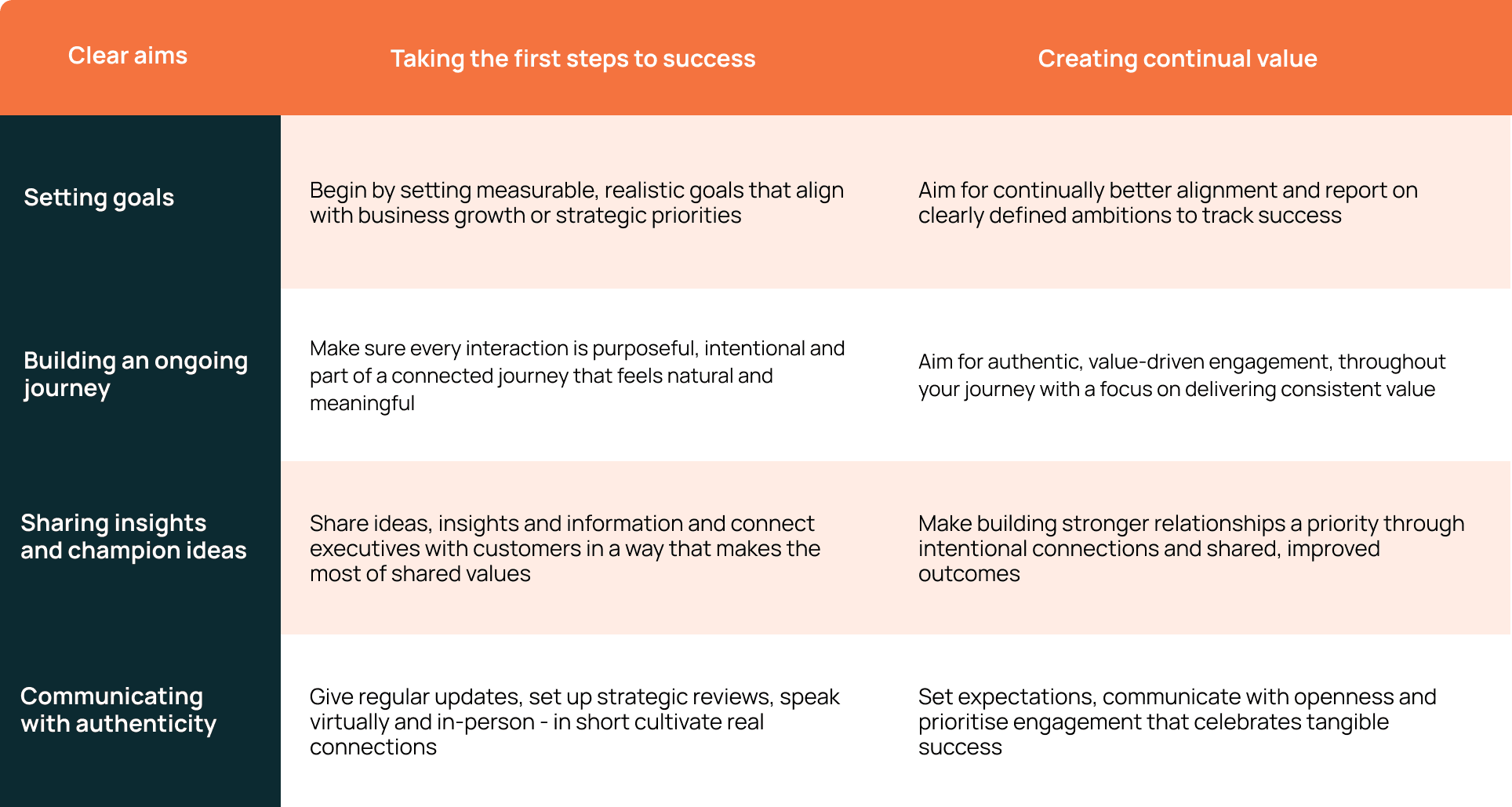
4. What brings executives in, and what keeps them coming back?
To successfully bring executives into this journey as an experience you’re building, you have to understand what truly matters to them. Here’s what we’ve learned that works:
What brings executives in?
What keeps them in?
What does a scalable online and offline executive engagement program look like in the real world?
Top tip: identifying your list of target executives and gathering social intent at the same time (what kind of topics matters to these executives right now) will support the development of real relevance in your messaging, content, and can inform a targeted calendar of specific tactics e.g. topic-focused in-person events.
Top tip: We help multitudes of customers build their structured value proposition to engage executive customers - aligning to strategic business goals and answering these with critical value, use cases and differentiation. We have found that by creating a unified narrative that is agile and adaptive, you can adjust with time effectively and stay on the front-foot with executives.
Top tip: “Thought Leader” LinkedIn ads are a great format for starting and engaging in conversations with execs without leaving LinkedIn - supercharging your sales navigator and placing relevant content in-front of execs, through paid channels, who would otherwise miss it.
5. What kind of online program components can you use for executive engagement programs?
Give your target execs a centralized space where they can find exclusive content, connect with peers, and explore what your community has to offer. Bonus points if you create a flexible space that allows you to spin up personalized versions for specific executive personas, or even individual accounts / executives.
Enlist your customer execs to co-create the community. The best communities aren’t built for execs, they’re built with them. Invite existing customer execs to help shape the program, enroll their peers, or share their stories
- What kind of offline program components can you use for executive engagement programs to orchestrate those moments that matter?
Orchestrate the moments that matter.
Strategic engagement isn’t just big events, it’s the little things: peer-to-peer connections, job change outreach, curated follow-ups, or briefings timed to business inflection points. These moments are where real relationships are forged. As engagement in your community grows, you’ll start to see opportunities for more tailored, one-to-one moments.
Event plans are moving the same way. In Forrester’s Q1 2026 State of B2B Events Survey of more than 400 event decision-makers worldwide, nearly 70% of organizations are reducing the number of events they run, a majority plan more intimate networking events and in-person events under 200 attendees, and just 18% plan more large hosted events.
7. Measuring the success of your executive program
Executive engagement is often most easily assessed using subjective or anecdotal measures, but securing investment in such programs requires quantifiable evidence of impact.
Since executive programs are typically aligned with long-term business strategy and the creation of shared value, the most effective approach combines both quantitative metrics - such as the number of new executive connections - and qualitative insights, like stories that highlight deeper relationships and strategic partnerships.
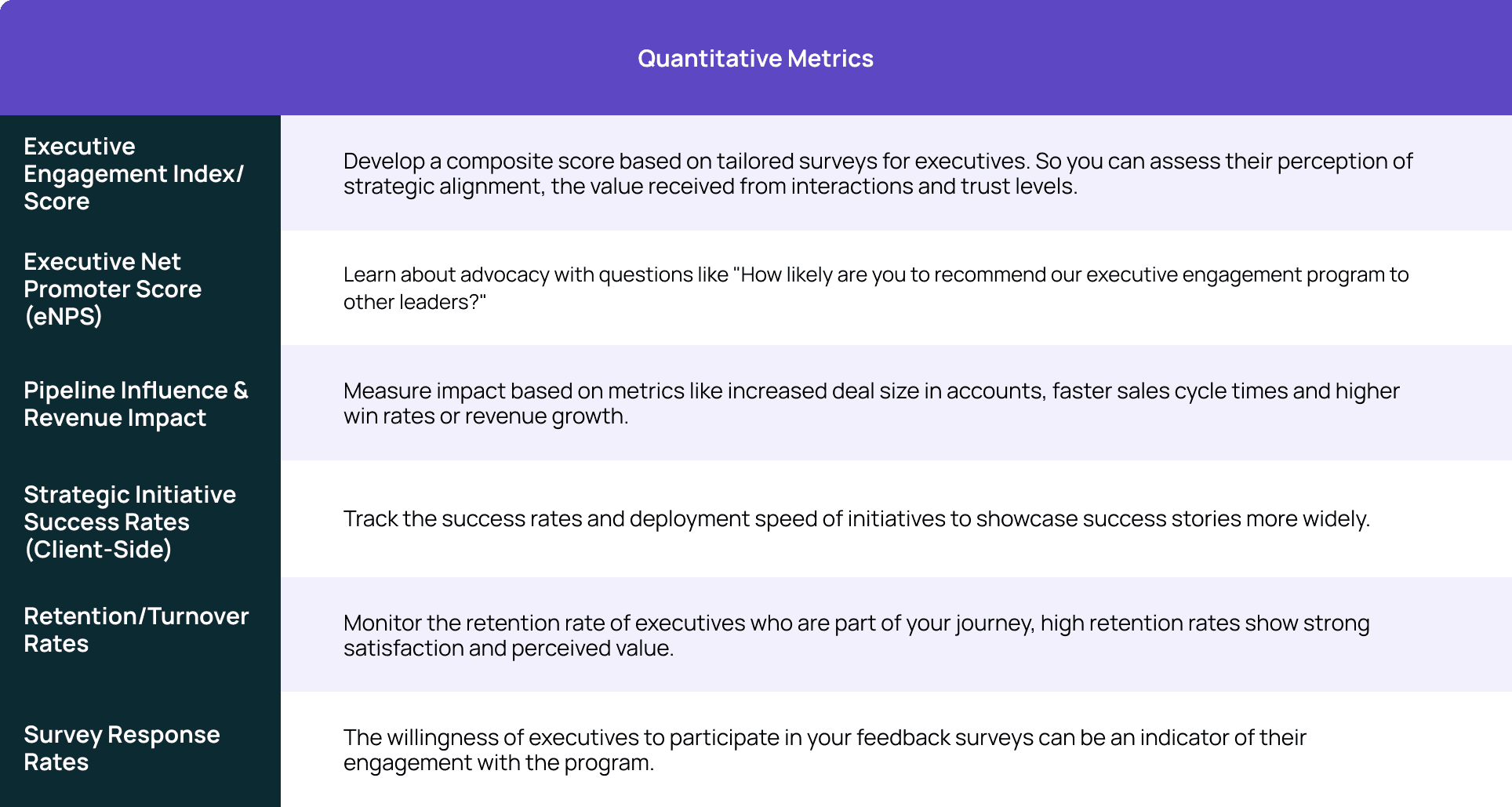
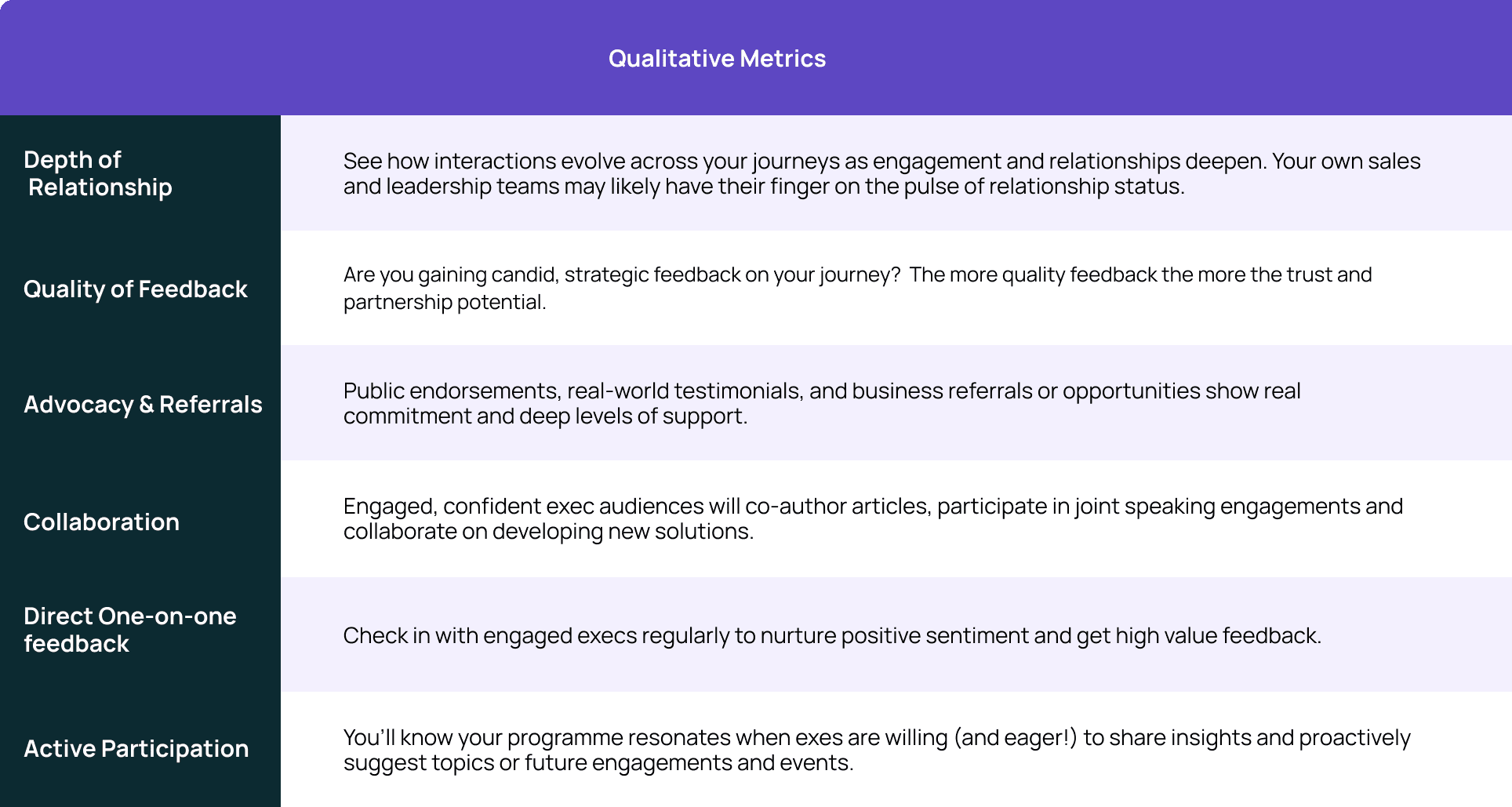
Other possible executive experience success metrics might include:
Be wary of measuring these programs on leads. For over half of organizations in Forrester’s Q1 2026 events survey, net-new lead generation is the primary objective, which Forrester warns drives overly simplistic measurement, and just 38% of CMOs in that survey agree their events are performing well.
8. In summary
Executive engagement is no longer a standalone tactic. It’s a strategic, ongoing experience - a journey that must be designed with care, intention, and executive personas at its heart.
By shifting from engagement to experience, marketing teams can build executive relationships that deliver value well beyond the next meeting.
The question isn’t “how do we get this exec to respond?”—it’s “how do we create something they never want to leave?”
Here is how we put that into practice for clients.
Executive engagement, powered by insight
Engaging key executives and standing out in highly competitive markets is tough. It's a battle for relevance across the entire customer lifecycle.
A proven specialism that helps our clients win
Buying decisions are increasingly self-guided, buying groups have grown in size and complexity, demographic changes and preferences challenge and spend is under greater scrutiny. To succeed, it is critical to engage with relevance and authenticity throughout the buying journey, which requires a proven, thought-through approach, grounded in insight.
By combining a proven framework and our specialist teams, we deliver both end to end executive engagement programs and point consultancy and solutions, helping organizations stand up executive engagement programs or extend and refine existing programs.
A proven framework that helps you navigate executive engagement
Our proven executive engagement framework helps structure and deliver stand-out programs based on insight.
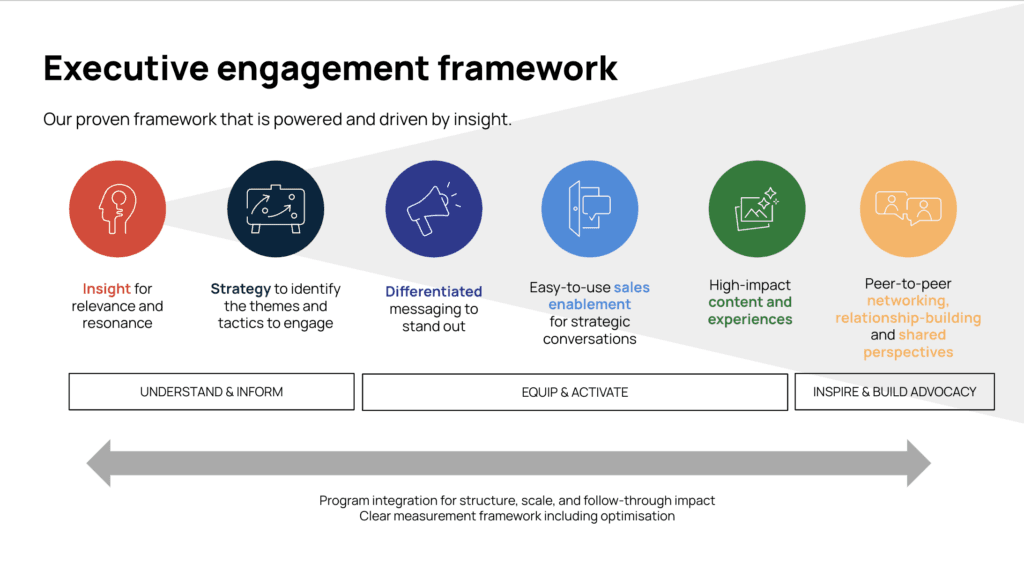
Common question we help answer, include:
Helping Adobe power C-suite engagement and understanding
How could Adobe identify the topics, themes and issues directly relevant to the specific executives in question then use this insight to inform and steer all of its content? Answer: Leverage our Executive Engagement program strategy.
Executive insight to inform your strategy
Successful executive engagement hinges on having a deep understanding of the target audience to ensure subsequent content and conversations are relevant and impactful. Insight drives this understanding with a scientific report of your audience’s priorities, pain points and preferences. Social executive intent helps understand buying triggers which inform your program strategy and optimize outreach.
Key features:
Strategy for structured engagement
The goals haven’t changed - demonstrating trust, collaboration and innovation, deepening relationships and growing value. But successfully engaging executives who are also being targeted by your competitors isn’t easy.
Insights gathered should directly inform a structured plan of executive engagement across key themes, messaging, tactics, channels and importantly the key executive players on your side for peer-to-peer engagement.
Key features:
Differentiated messaging that cuts through the noise
Robust and personalized messaging development will show that you understand the specific issues and opportunities executives are facing - while illustrating best practice examples, and clearly communicating how your offer aligns.
Deep personalization at some scale can be achieved by identifying your broader value proposition and adjusting the elevator pitch to closely answer the needs of specific executives or executive groups.
Key features:
More than a game: insight-driven, creative campaign to engage key stakeholders
LinkedIn needed to persuade one of the world’s biggest gaming brands that its platform stretches beyond B2B audiences and establish its credibility as a place for gamers, too. Our high spec direct mail concept showcased the power of direct mail to reach key execs and landed the deal for LinkedIn!
Exec-centric sales enablement for strategic conversations
When it comes down to it, impactful targeting tactics must translate into clear, collaborative conversations that show value aligned directly to executive need. Equip your key executive sponsors and sales team with easy-to-digest messaging, personalized meeting content and support to navigate the critical conversations.
From executive sales presentations to role-specific conversation guides and battlecards, elevate what might have been a product-focused conversation into a strategic, customer-centric conversation around the individual’s needs, challenges and why you are the right partner to work with.
Key features:
High-impact content and experiences
Bringing together powerful insight, a clear strategy and differentiated messaging to power content, experiences and communications that elevate your offer in the minds of executives. Whether this is top-of-funnel content that makes your brand visible at the start of the buying journey, striking direct mail that forces your target to take notice, or highly personalized interactive experiences. Make your offer irresistible and your competition irrelevant.
Key features:
Building, sharing, collaborating: the peer network
The exchange of information between peers remains important for executives. But in the digital age, this exchange happens over social networks, with peers they likely haven’t met. Engaging with peer networks requires you to identify the community of executives, target with relevant messaging and content through online and events, share unique perspectives on market and emerging issues, and foster a safe (online and offline) space of collaboration.
We have proven experience in supporting these peer-to-peer narratives - through thought leadership content and social selling programs, roundtable discussion and webinars, executive briefing center narratives, networking event narratives and content.
Key features:
To see which of these practices your team already does well, take the 15-minute Buyer Group Index assessment.
Common questions
What is an executive engagement program?
An executive engagement program is a structured, continuous run of content, events and communications aimed at senior decision-makers in priority accounts, designed to build a relationship over time. A single event can be part of one, but the distinguishing feature is continuity: the executive hears from you between meetings, and the next meeting starts where the last one stopped.
What goes in an executive engagement strategy?
An executive engagement strategy names the executives you are targeting and why, the themes they care about, the formats you will use, which of your own leaders will carry the peer-to-peer conversations, and how you will measure depth of relationship. Insight about those specific executives comes first, because the themes, channels and sales tools all depend on it.
What makes executives attend and keep attending?
Access to peers they respect and to expertise they cannot get elsewhere brings executives in. What keeps them there is genuine participation, fresh material each time, and a clear sense that their time is being respected. An executive who only ever listens has no particular reason to come back.
How do you measure executive engagement?
Measure depth of relationship: repeat participation, stakeholder coverage across priority accounts, executive-level meetings generated, and influence on pipeline progression in those accounts. Headcount at a dinner is an activity measure. Pair the numbers with named stories of what changed in an account, because finance will read the numbers and your sponsor will repeat the stories.
More of this in your inbox
Lottie Forbes BrownOriginal author
Published in:
Subscribe to our updates.
Get fresh marketing insights rooted in customer science to help you stay ahead.
Relatedcontent

Getting to grips with GEO: Making sense of the noise.
Make sense of generative engine optimisation (GEO), what still matters in SEO and how B2B marketers can test search advice and create content worth citing.Read more

Beyond the briefing: how the best technical media conversations build lasting B2B credibility
Discover how technical media conversations at Pretzl Connect helped sharpen company narratives, inspire useful content and build lasting credibility in B2BRead more

From Leads to Buying Groups: The Next Evolution of B2B Marketing
Why buying group marketing is fundamentally changing the way we go to market, personalise experiences and measure success.Read more