

Jessie Tracy has been working in B2B tech for over 20 years, advocating for the craft of creative that can drive accountable performance excellence and was the previous CEO of the marketing agency Velocity Partners. She's evangelical that the best results come from a true client and agency partnership.
View Jessie Tracy’s postsPublished in:
23 mins read
The B2B content marketing strategy checklist
Eighteen steps for building a B2B content strategy and pressure-testing your next piece, updated for buying groups and AI answers.
A B2B content marketing strategy is a written summary of who you want to reach, what you need them to do, what you’ll create to get them there, how it will reach them and how you’ll measure success. The 18 sections below will get you one.
A big, fat, roll-up-your-sleeves guide for B2B marketers from your favorite B2B content marketing agency.
Content marketing used to be a secret weapon used by the smartest marketers. Now it’s the default setting used by just about everybody.
What does this mean for you?
It means you can’t just shoot from the hip anymore. Now you need to take aim and get strategic.
That’s what The Content Marketing Strategy Checklist is all about: helping you get strategic about your content program so your stuff hits the target and you maximize your Return on Content.
Do it right and you’ll earn more traffic, drive more conversions, improve your search rankings and build a formidable content brand (one of the most precious assets a B2B marketer can create).
What’s inside
Content marketing has exploded
That’s good because you’ve finally got a way around those annoying barriers that buyers tend to erect when they sense old-school marketing.
But it’s bad because it means you’re competing against a tidal wave of shiny new content from competitors, analysts, thought leaders, bloggers and wannabes.
Bottom line: good content isn’t enough any more. You need insanely great content that’s on-strategy and incites action. And you need to deliver it in a consistent, ongoing program.
To do that, you need to step back a little and think about what you’re trying to accomplish and who you’re trying to motivate.
This is the era of Content Strategy and it will separate the pros from the amateurs.
Why content is so critical
Content is so critical because people care about their own problems much more than they care about your products.
When you capture your company’s expertise and package it up to help your prospects do their jobs, you earn people’s attention instead of simply assuming you’ll get it.
Content also fuels the three most important weapons in the B2B marketing arsenal:
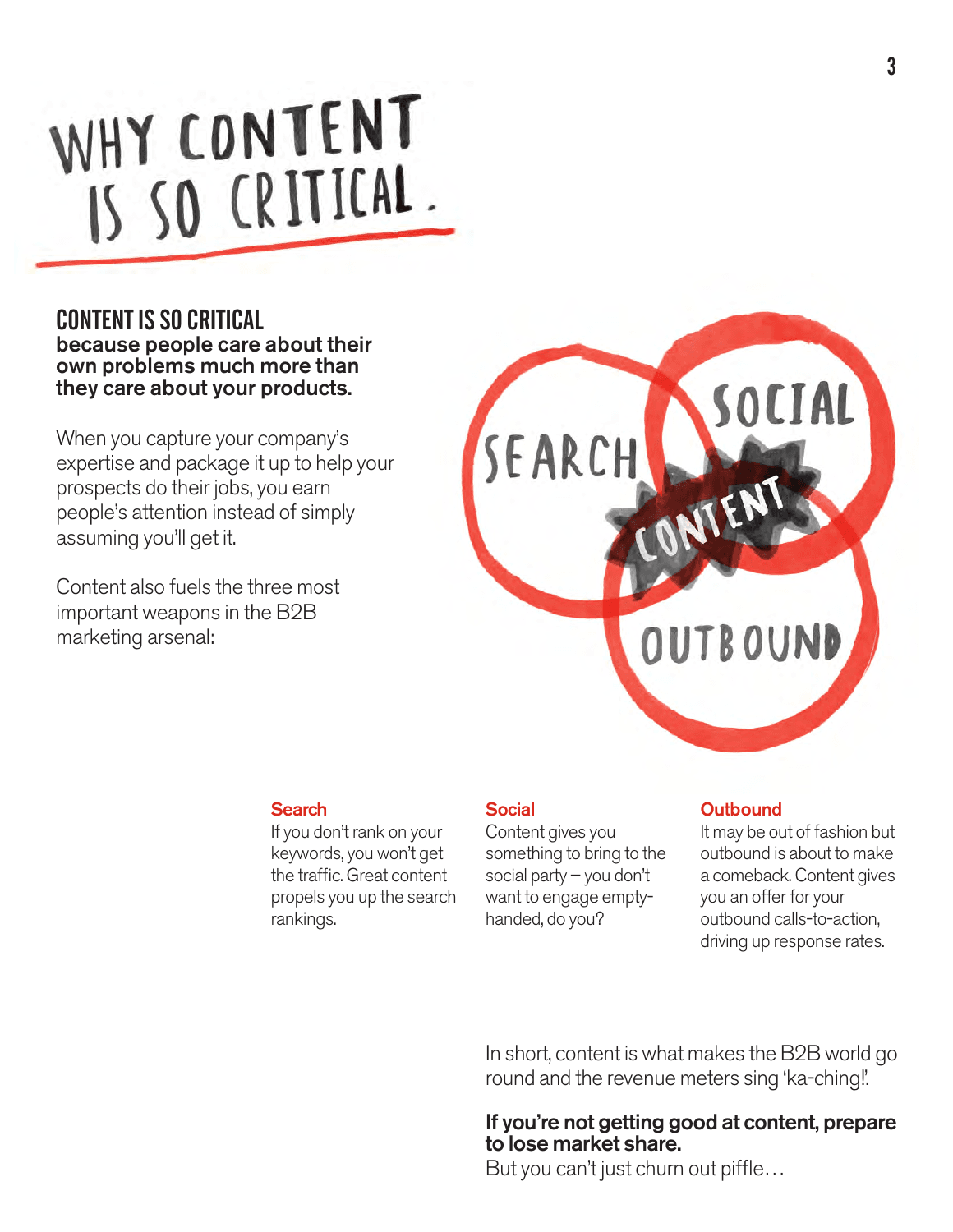
In short, content is what makes the B2B world go round and the revenue meters sing ‘ka-ching!’.
If you’re not getting good at content, prepare to lose market share.
But you can’t just churn out piffle…
Here’s a big, fat checklist to help
The first part of the checklist is designed to help you hone your content marketing strategy and build the foundations of an ongoing content marketing program. The second part should help you attack your very next piece.
We hope you won’t just read the checklist. We hope you’ll print it out and start scribbling away. Use it when you’re writing your content marketing strategy, developing a new piece – or whenever you hit a roadblock.
You may need to do this exercise for each product line or one for each region or whatever. But these are the kinds of questions you’ll need to answer if you want your content marketing to go faster than a speeding bullet and leap over tall buildings in a single bound (or a series of carefully nurtured smaller bounds).
Help us help you
If you think we’ve missed anything important or got something totally wrong (how very dare you), do give us your comments. We want to improve this sucker as we go forward.
Ones we prepared earlier. You mean you haven’t read these yet?
There’s your bedtime reading for tonight. Enjoy. Night-night. Mwah.
What has changed since this checklist first ran?
Who buys, where they look and what you can prove have all changed since 2013.
Forrester’s State of Business Buying 2026, based on a survey of nearly 18,000 global business buyers, found that the average decision involves 13 internal stakeholders and nine external participants, and that 94% of buyers use AI during the process.
Ahrefs compared 300,000 keywords and found that in December 2025 an AI Overview correlated with a 58% lower average clickthrough rate for the top-ranking page. In the Content Marketing Institute and MarketingProfs survey of 861 B2B marketers (June to August 2026), 31% said website traffic rose over the past year, 31% said it fell and 14% don’t track it.
Pretzl’s 2026 Buyer Group Index, with the ANA and NewtonX, surveyed 200 senior go-to-market leaders and ranked 28 practices by their link to commercial outcomes. Several of those practices come up below.
Get out your pencil.
Part 1: The big picture
To help you think about your whole content marketing program:
Goals
Start big and work your way down:
For each goal you choose, identify the metrics you’ll track.
Think about what you’d need to change to make these goals happen – and aim high. This isn’t just about business as usual.
Prioritize the most important things content can do for you, including:
Get buy-in on these. Everything depends on clear goals that everyone agrees on – and build them into your analytics! (see Measurement & testing, below).
For this B2B Content Marketing Strategy Checklist, the goals are: To raise awareness of Pretzl among B2B marketers who want to harness the power of content marketing. To nurture people who downloaded and liked the B2B Marketing Manifesto or the B2B Content Marketing Workbook, moving the right ones one step closer to picking up the phone.
Target audiences
Summarize each buyer persona in a few bullet points and prioritize:
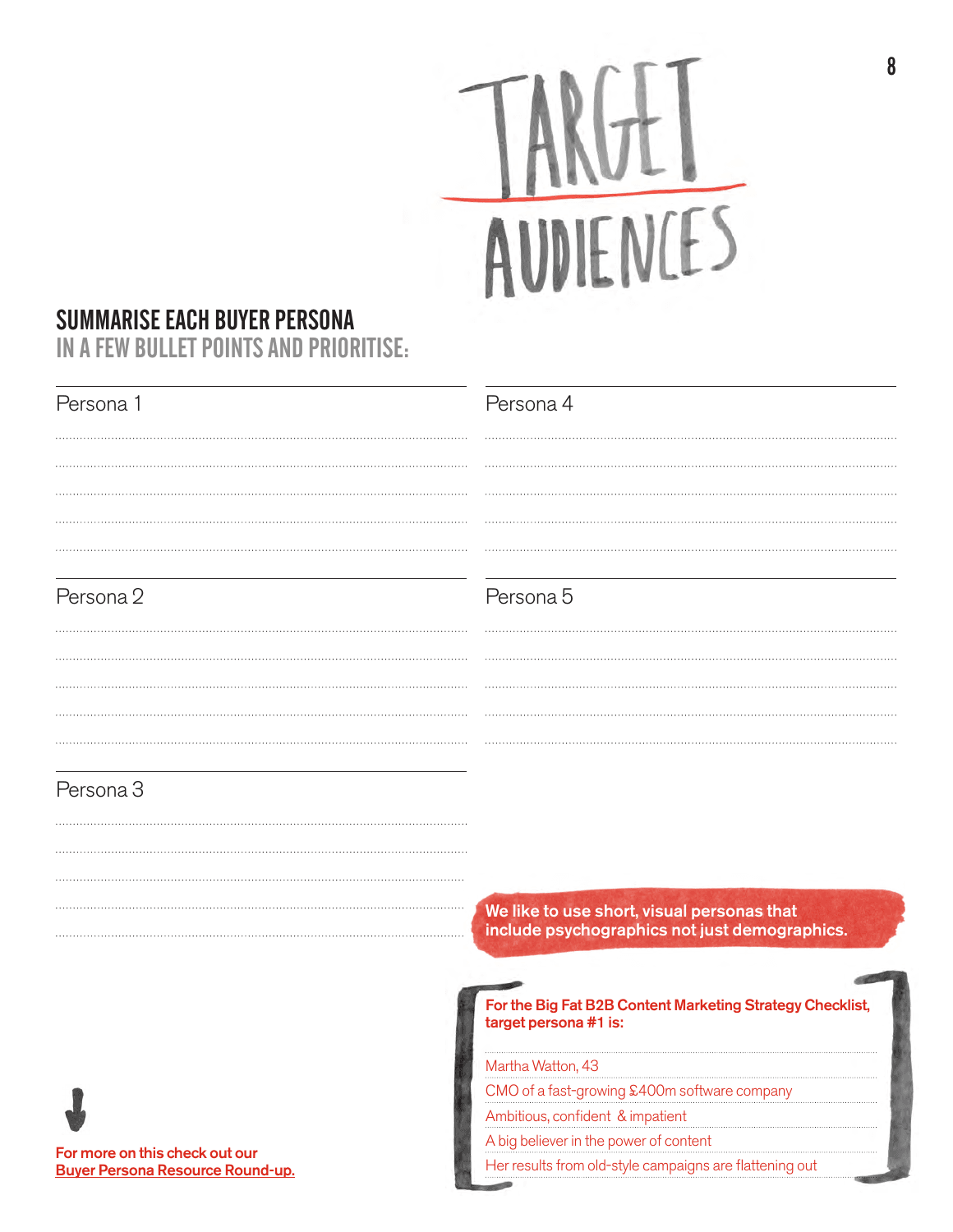
We like to use short, visual personas that include psychographics not just demographics.
A persona rarely buys alone these days. With 13 internal stakeholders and nine external participants in the average decision (Forrester, 2026), add a line for every role in the buying group, including the people who rarely fill in forms. Forrester also found that procurement professionals are decision-makers in 53% of business buying cycles, so bring them in early.
For the Big Fat B2B Content Marketing Strategy Checklist, target persona #1 is: Martha Watton, 43 CMO of a fast-growing £400m software company Ambitious, confident & impatient A big believer in the power of content Her results from old-style campaigns are flattening out
Target buying stages
Each piece of content should cause a prospect to move to the next stage of the buying journey.
Fill in your top personas and use AIDA or whatever buying stages you prefer:
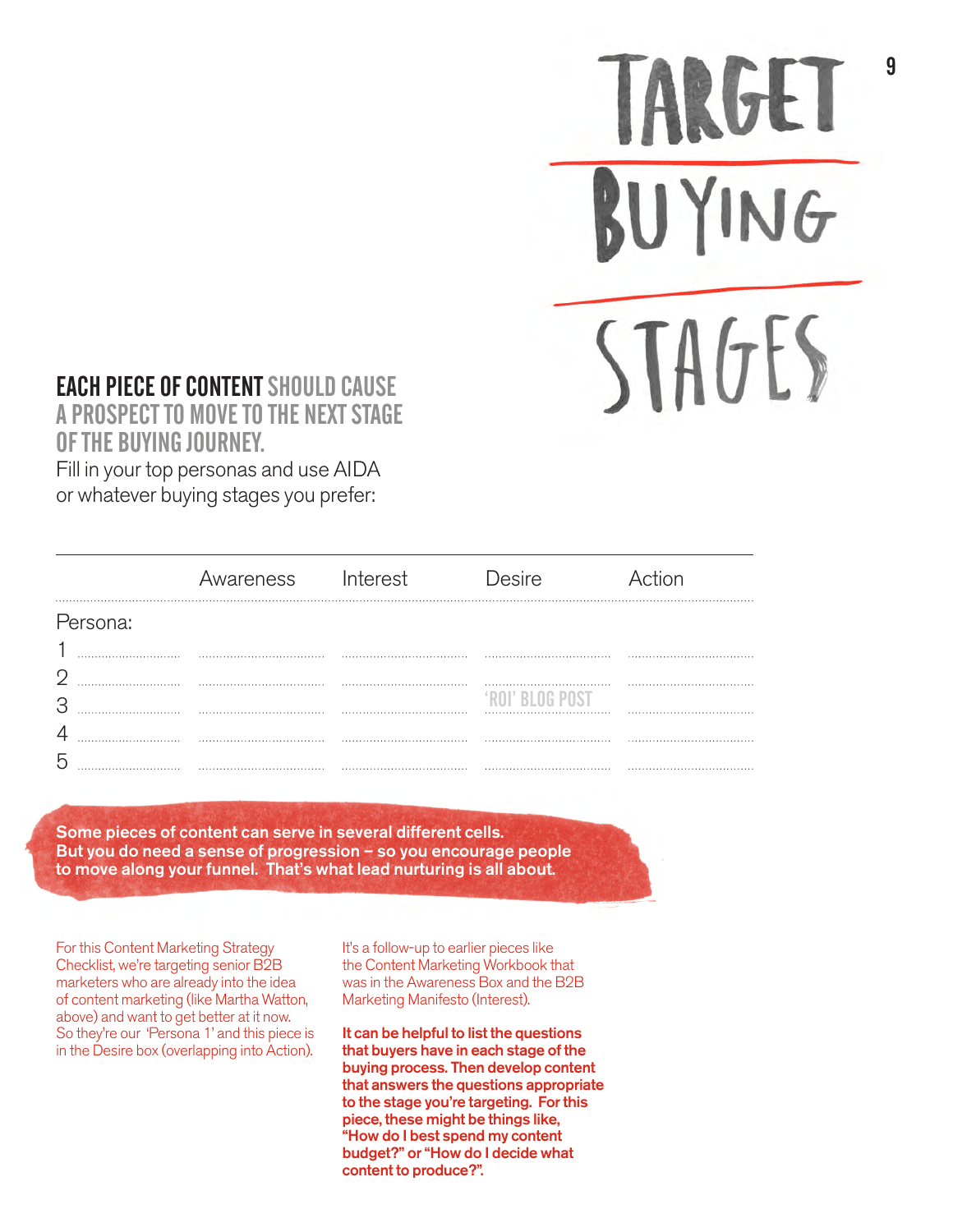
Some pieces of content can serve in several different cells. But you do need a sense of progression – so you encourage people to move along your funnel. That’s what lead nurturing is all about.
Journey content, meaning content tailored to each stage of a buying group’s journey, ranks 10th of 28 practices in the Buyer Group Index, so this grid is worth an afternoon.
For this Content Marketing Strategy Checklist, we’re targeting senior B2B marketers who are already into the idea of content marketing (like Martha Watton, above) and want to get better at it now. So they’re our ‘Persona 1’ and this piece is in the Desire box (overlapping into Action). It’s a follow-up to earlier pieces like the Content Marketing Workbook that was in the Awareness Box and the B2B Marketing Manifesto (Interest). It can be helpful to list the questions that buyers have in each stage of the buying process. Then develop content that answers the questions appropriate to the stage you’re targeting. For this piece, these might be things like, “How do I best spend my content budget?” or “How do I decide what content to produce?”.
Trigger events
Another way to target content is to think about the events within the target company that might trigger interest in your solutions (a merger? A new CRM system?):
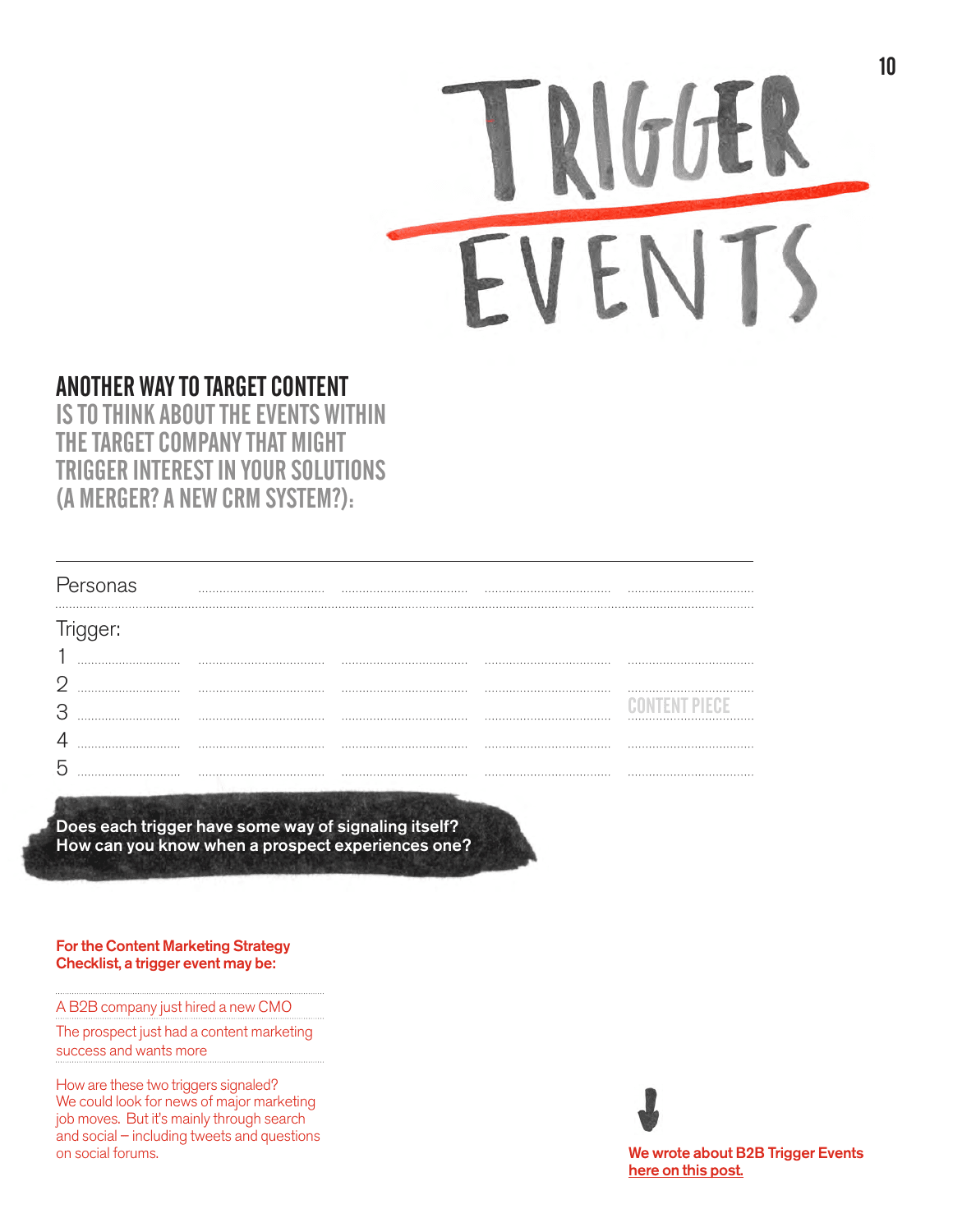
Does each trigger have some way of signaling itself? How can you know when a prospect experiences one?
Those signals have become harder to see. In follow-up interviews for the Buyer Group Index, with about 30 executives, 60% said most buyer research happens outside a vendor’s visibility.
For the Content Marketing Strategy Checklist, a trigger event may be: A B2B company just hired a new CMO The prospect just had a content marketing success and wants more How are these two triggers signaled? We could look for news of major marketing job moves. But it’s mainly through search and social – including posts and questions on social forums.
Sweet spot
The best content comes from a very specific, clearly delineated sphere of expertise.
This is the zone where you have the most authority. It’s where no one has a better claim on expertise than you do. Write yours in a sentence:
Our sweet spot is:
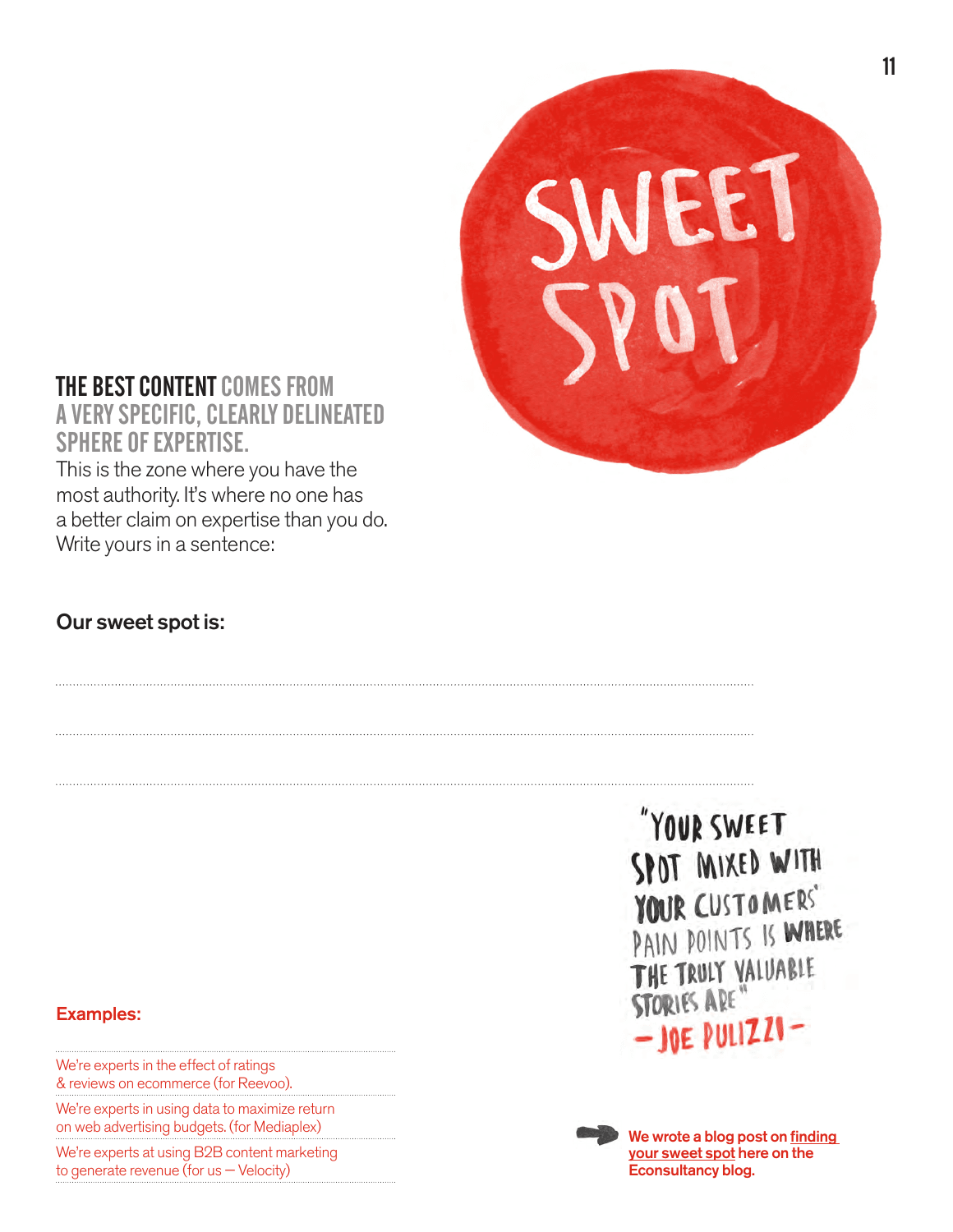
Examples: We’re experts in the effect of ratings & reviews on ecommerce (for Reevoo). We’re experts in using data to maximize return on web advertising budgets. (for Mediaplex) We’re experts at using B2B content marketing to generate revenue (for us — Pretzl)
Content audit
Few companies start with no content. It’s important to know exactly what you have so you know where your gaps are.
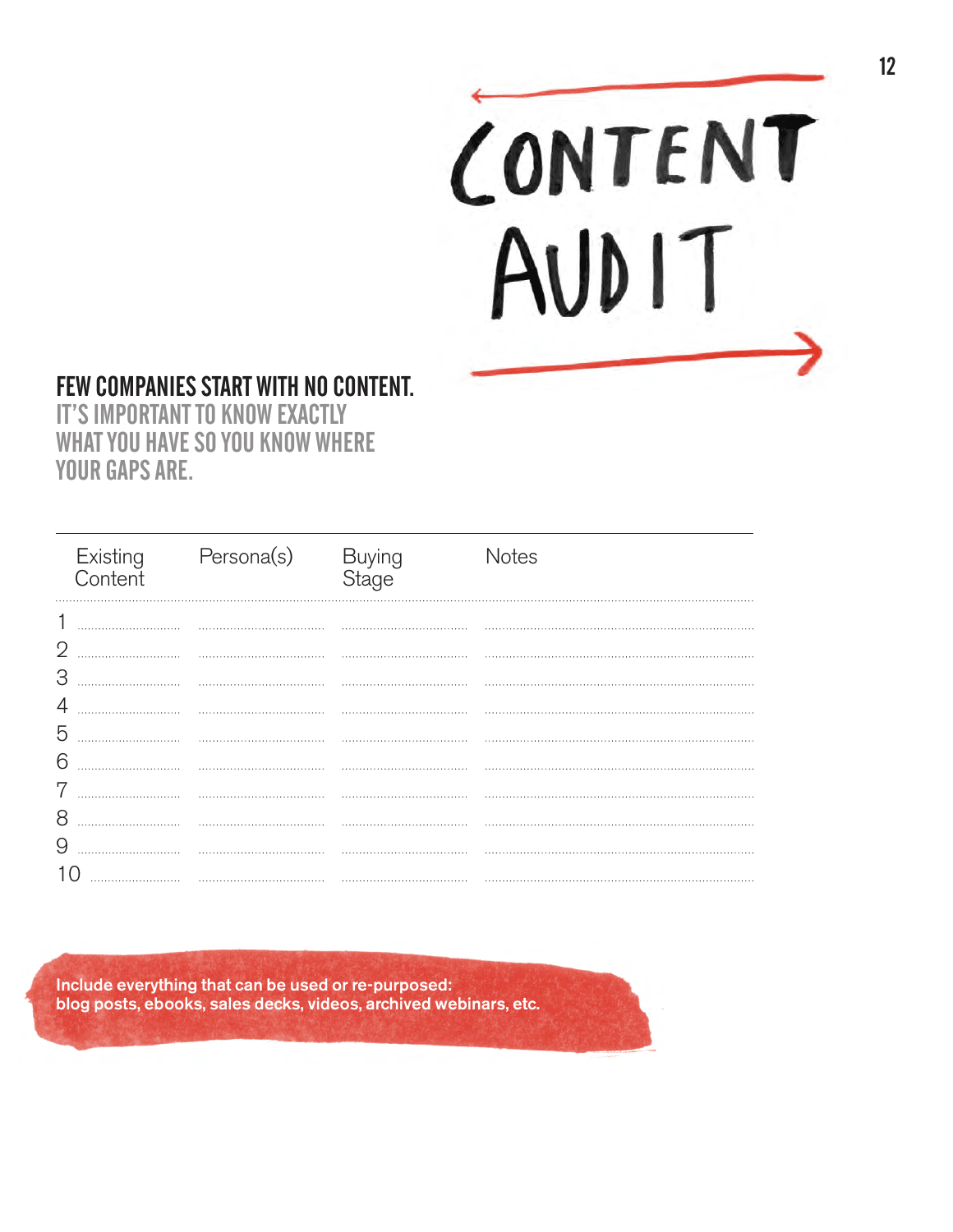
Include everything that can be used or re-purposed: blog posts, ebooks, sales decks, videos, archived webinars, etc.
Flag stale claims and numbers while you’re at it, because AI answers will happily repeat them on your behalf.
Themes
Themes are wider in scope than specific topics. They represent a whole area you want to start ‘owning’. Decide on your content success criteria and score each theme against them.
Kind of like this (in priority order):
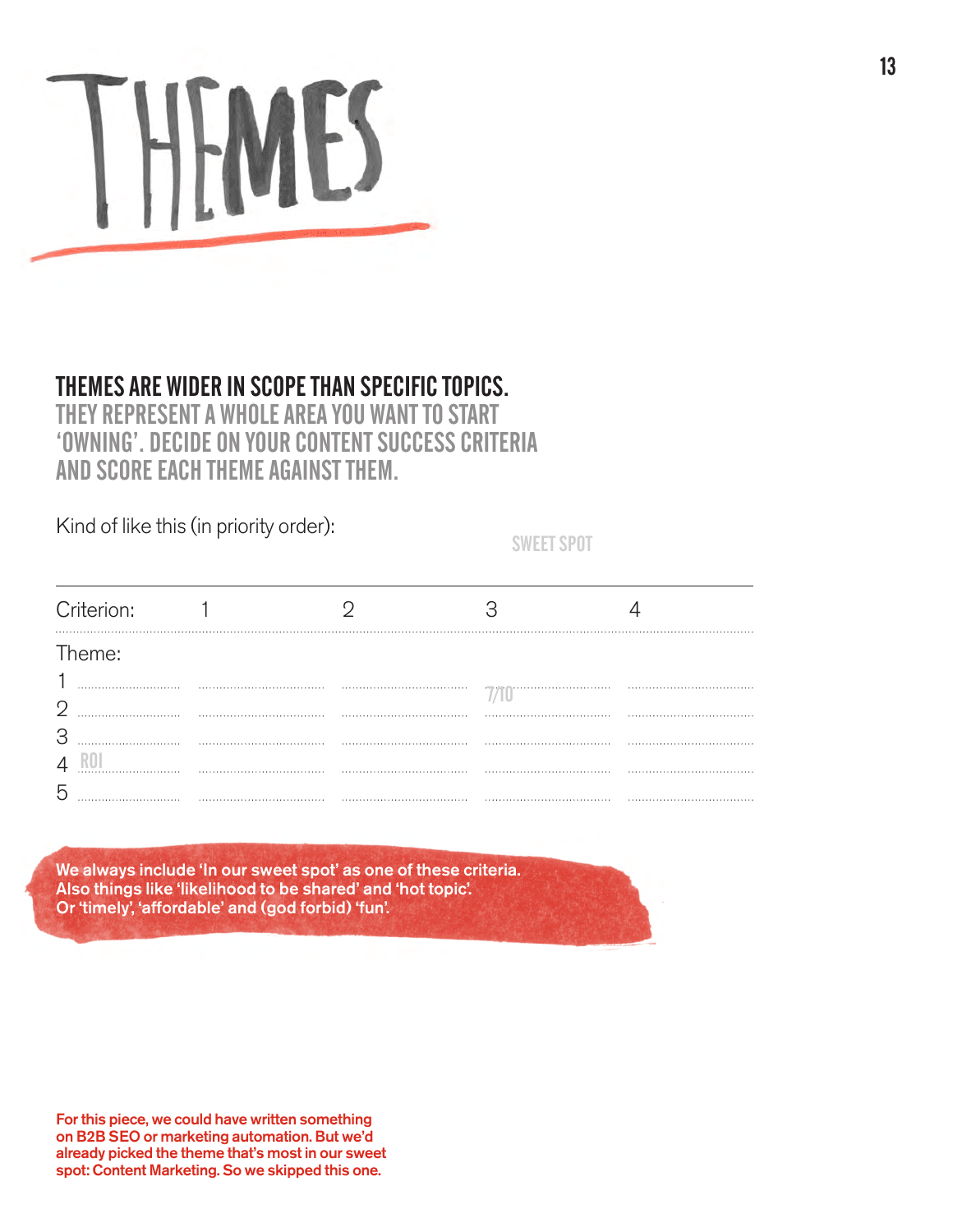
We always include ‘In our sweet spot’ as one of these criteria. Also things like ‘likelihood to be shared’ and ‘hot topic’. Or ‘timely’, ‘affordable’ and (god forbid) ‘fun’.
Value realization, content that tells buyers how to solve their own problems, ranks 12th in the Buyer Group Index. Edu vs vendor content, the balance of educational and branded material, ranks 17th, and the market scores Low on it.
For this piece, we could have written something on B2B SEO or marketing automation. But we’d already picked the theme that’s most in our sweet spot: Content Marketing. So we skipped this one.
SEO keyphrases
It’s good to decide on your SEO keyphrases before you pick a topic – but it’s critical to do so before you start writing.
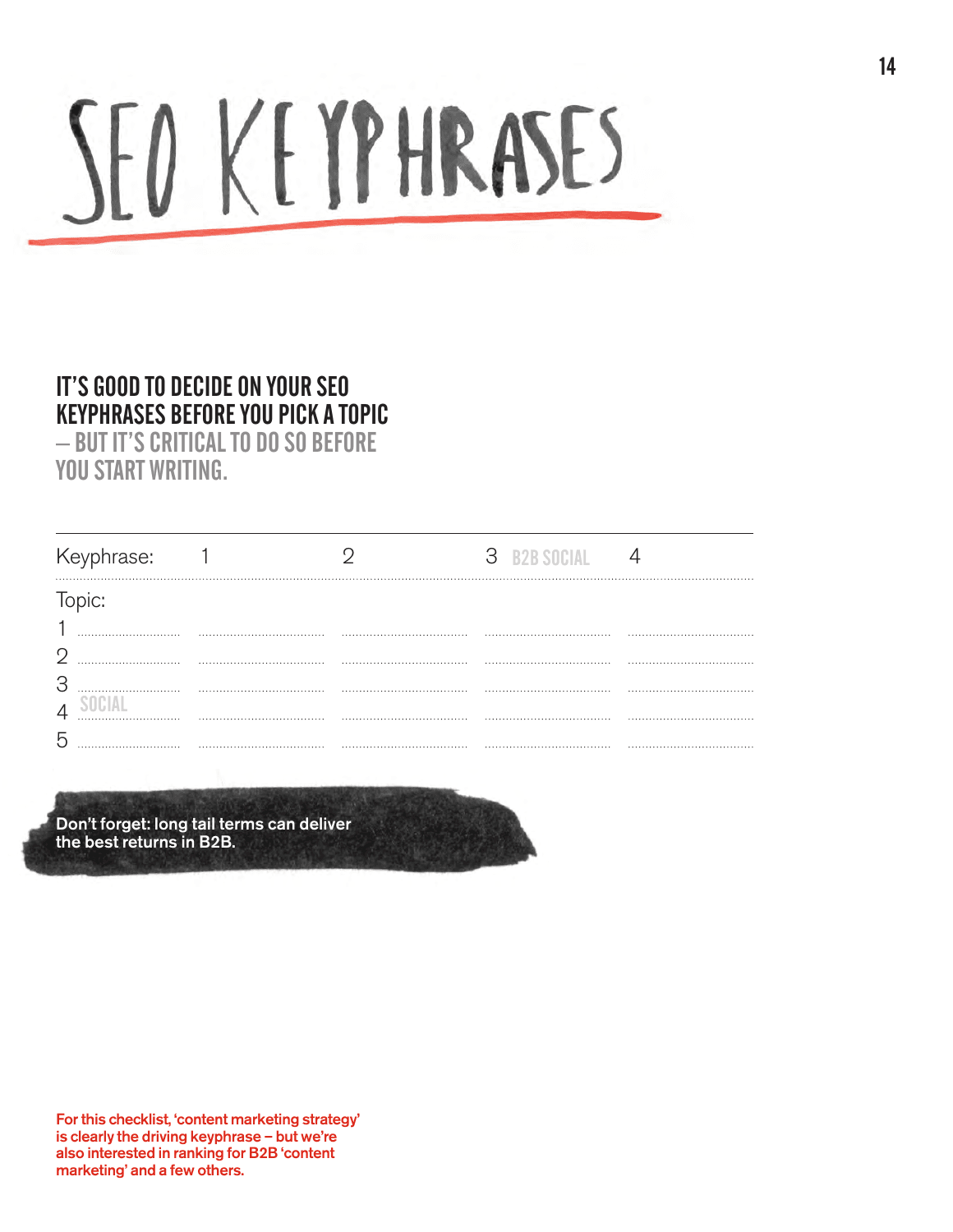
Don’t forget: long tail terms can deliver the best returns in B2B.
Do the same for the questions people now put to AI tools, written the way a person would ask them, and give each one a passage that answers it in the first sentence.
For this checklist, ‘content marketing strategy’ is clearly the driving keyphrase – but we’re also interested in ranking for B2B ‘content marketing’ and a few others.
Editorial calendar
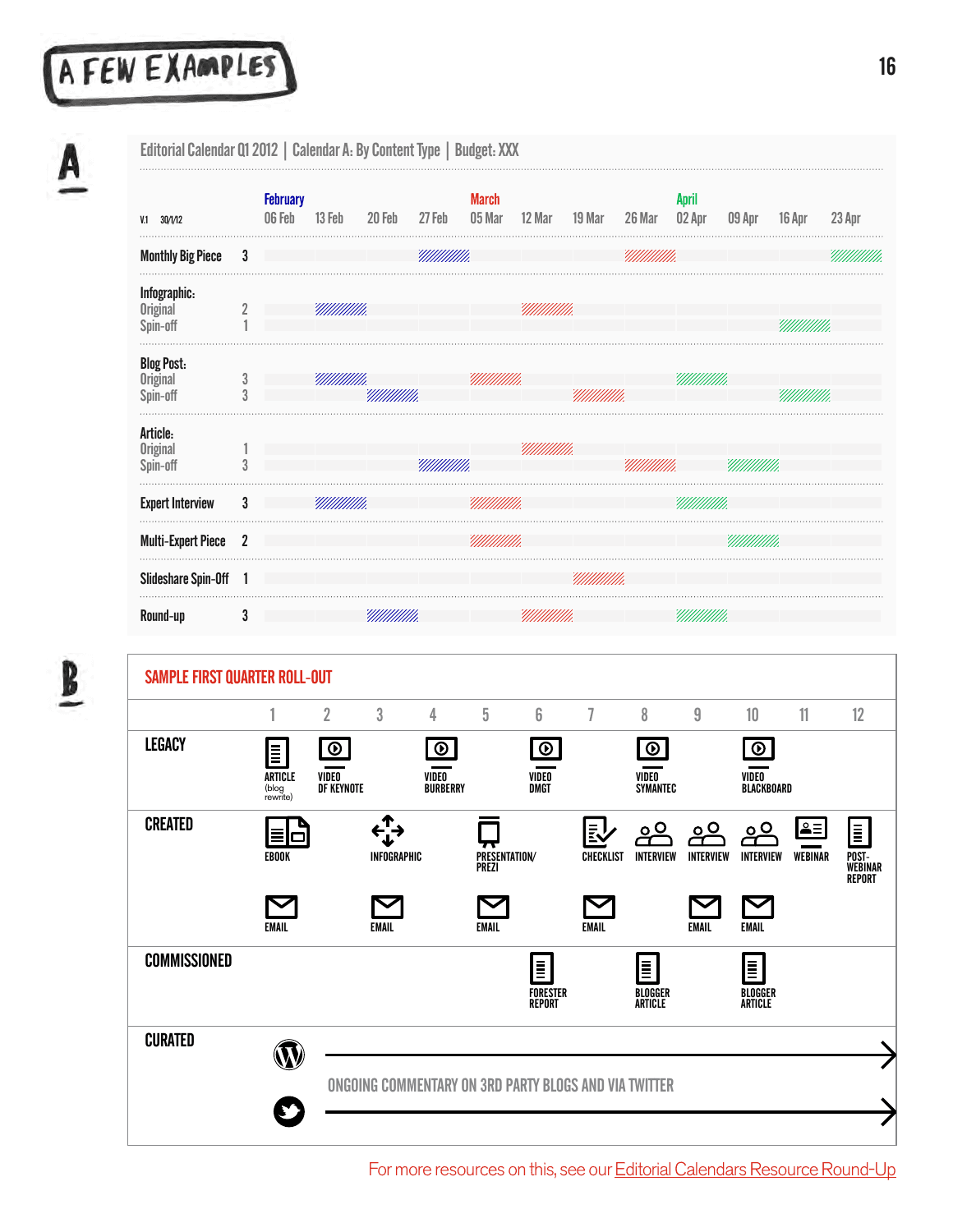
Your editorial calendar is essentially your production and delivery schedule in one sheet.
If you don’t have one, your content marketing will become ad hoc rather than strategic. So have one (even if you stray from it often).
Here’s a simple one: Months or weeks along the top. Personas, stages, triggers, topics or a combination down the left. You decide:

A few examples:
Part 2: Now focus on your next piece
Here’s some help creating it:
Topics
For each cell in your persona / buying-stage matrix, you need to generate topic ideas.
Just as in the ‘themes’ section above, decide on your content success criteria and score each topic against them:
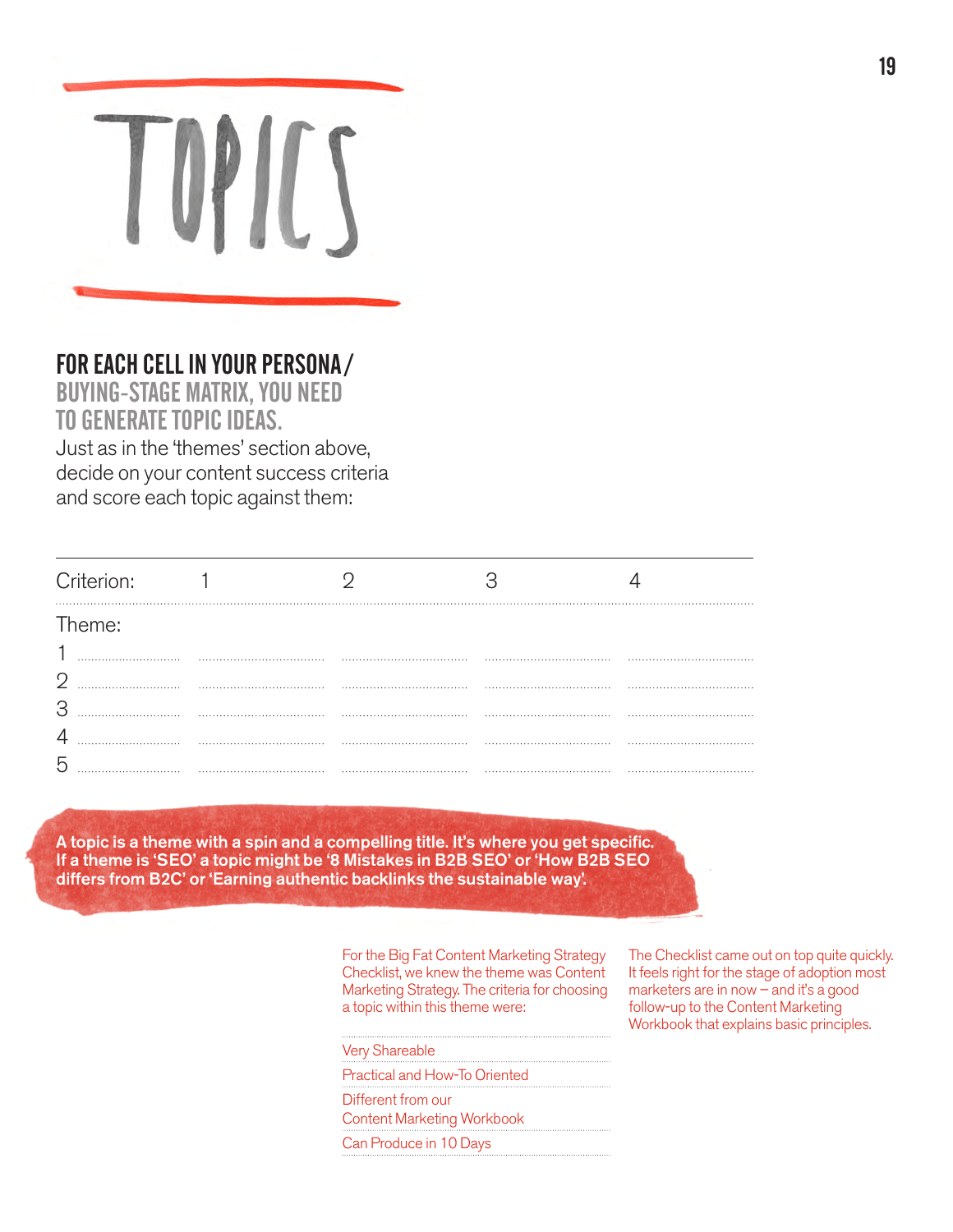
A topic is a theme with a spin and a compelling title. It’s where you get specific. If a theme is ‘SEO’ a topic might be ‘8 Mistakes in B2B SEO’ or ‘How B2B SEO differs from B2C’ or ‘Earning authentic backlinks the sustainable way’.
For the Big Fat Content Marketing Strategy Checklist, we knew the theme was Content Marketing Strategy. The criteria for choosing a topic within this theme were: Very Shareable Practical and How-To Oriented Different from our Content Marketing Workbook Can Produce in 10 Days The Checklist came out on top quite quickly. It feels right for the stage of adoption most marketers are in now – and it’s a good follow-up to the Content Marketing Workbook that explains basic principles.
Media
You’ve got a topic. Now what medium is best for it?
Prioritize according to things like the size and scope of the topic, the need to gate behind a download form, shareability, etc.
Think hard about that gate, because AI tools and search engines can’t quote what sits behind a form.
It’s good to keep a mix of different media – it’s a lot more interesting than a library of 19 white papers. And try new stuff. Prezi, Podcast, Infographic, LinkedIn carousel… The medium can be the message.
For this piece, a checklist presented itself as the obvious medium for a practical, hardworking piece that captures some of our experience in a short form – and hopefully really helps B2B marketers in their content marketing efforts. We’ll no doubt spin this out into blog posts and infographics and stuff. And we’ve already done a Prezi: The Content Marketing Tutorial. We like Prezi.
Information sources
Great content is authoritative.
Your choice of format will influence where you source your information (an infographic often needs different kinds of content than a webinar or eBook). So where will you get the goods?
You don’t have to consult all these sources before getting started. Once you feel you’ve nailed the topic, you can keep researching to validate your ideas but you might as well start writing your outline.
If AI tools are on your list, name one person who checks every fact they supply. In the CMI survey (861 B2B marketers, June to August 2026), 78% picked speed among AI’s contributions to content and 17% picked quality.
The Big Fat Content Marketing Strategy Checklist you’re reading right now is based mainly on our internal ‘chops’ – we’ve been doing this for a long time. But we did check in with our friends and marketers we respect (see the section at the end).
Tone & style
You’ve probably got a target tone of voice or ‘look & feel’ in your mind.
Share it with the writers and designers who will be creating the content:
You don’t want to tie the hands of your creatives (heaven forfend) – just give them a sense of where you’re aiming.
You might think it’s hard to get tone and attitude into a checklist like this one – but it’s the little glosses like this one that add that human touch. We hope. On the design front, we aimed for: ‘working doc but kind of fun and engaging to look at’.
Now flog it
You’ve got great content. Now get it out there, atomize it and measure its impact.
Promotion
Thinking about this before you create the content can help you spin it for maximum impact. But it’s good as a post-creation checklist too:
Your own channels
Influencers, bloggers, partners, & mates (online PR)
Social Media
Paid media
In our experience, marketers tire of a piece of content far before the audience does. Hit it and hit it again. Then hit it some more.
Lead nurturing
No, you can’t just unleash your sales animals on everyone who downloads an ebook. You need to be scientific about it.
Using lead nurturing will allow you to use your content where it belongs in a prospect’s ‘journey’ (instead of just throwing it at everyone who’s in your database today).
So a new prospect who might sign up for your newsletter next January may get your new piece of content first – to them, it’s brand new! Nurturing does many good things for you but extending the life of your best content is a biggie.
The Buyer Group Index ranks Integrated discovery, an ongoing process shared by marketing and sales in place of a lead handoff, 9th of 28 practices.
Lead Nurturing Checklist
\* What, you don’t have a marketing automation and lead nurturing platform? Well… Go get one.
Here’s a sample 5-step nurture flow for Pretzl:
- Thanks for visiting our site
- Here’s our B2B Content Marketing Workbook
- Liked that? Check out our B2B Marketing Manifesto
- Ready to go? Here’s a Strategy Checklist to help
- Need content like the stuff you’ve just experienced?.... We should talk.
(Thanks to Maria Pergolino for suggesting this flow)!
Atomization
Turn each major content piece into lots of different related pieces, including:
Plan your atomization as you create each major content piece – and put all the spin-offs into your editorial calendar.
Of course, each of these spin-offs should link back to the mother ship – using the right keyphrases as anchor text.
We’ll atomize The Big Content Marketing Strategy Checklist in lots of cool ways, no doubt. Watch this space (and all the little spaces around it). Our mate Roger Warner calls this ‘versioning for shareability’. We kind of like that.
Measurement & testing
Work out what success really means for you and measure it.
The best content marketers tend to live inside Google Analytics (or their chosen tool). You don’t have to master it yourself (go on, it’s fun) but you do need someone on your team to master it.
Add AI answers to your reports by running a fixed set of prompts repeatedly and recording how often you appear. SparkToro’s 2026 research, 2,961 runs by 600 volunteers, found AI tools repeat the same brand list less than once in 100 tries.
Content effectiveness, knowing how content lands with each member of the buying group, ranks 18th of 28 in the Buyer Group Index.
Learning
The best content marketing organizations have learning cultures. It’s important to explicitly capture what has worked, what hasn’t and why you think it’s true.
Regular, informal meetings to share what you’ve learned – and hear what others have learned – are a great way to start to embed this learning in your marketing. They make the whole process more fun, too.
And back to the start we go
Now take all this priceless experience and put it to work for your next content marketing strategy, quarterly plan, campaign or next piece of content.
Here’s the Pretzl guarantee: this stuff works
Content Marketing is an energizing discipline. Every marketer will have their own approach based on their unique situation and experiences.
We hope this Big Fat Checklist helps you evolve your own best practice. And we hope you’ll share some of that with us.
Content Marketing is the effective part of B2B. Do it right and your budgets will increase, your sales teams will sing your praises and you’ll trade in that Ford Focus for one of those fancy foreign jobbies.
Do it wrong and your content will have the lifespan of a tweet. So our advice: do it right.
Five parting principles to keep you on track
- Start with what your prospects need to know. Not what you need to say.
- Stick to your sweet spot. Where your company is an undisputed expert.
- Have real ideas and write with passion. Confidence is the most powerful force in marketing – and a bit of attitude and energy go a long, long way.
- Less can be much more. Fewer major pieces of real value beat a firehose of lightweight stuff. You’re building a content brand here: you need to be famous for excellent content that’s worth people’s time.
- Live by the numbers. There’s no excuse for flying blind anymore. Analytics is to digital marketing as air and water are to the human body. And A/B testing is the… um… the kidney?
Some favorite content marketing folks & resources
No, we’re not the only content marketing strategists out there. We get inspiration, motivation and sometimes the howling fantods of envy by following:
Five excellent books:
Smart B2B content marketers and very nice people indeed who helped and/or inspire us:
Ardath Albee, Bob Apollo, Ambal Balakrishnan, Michael Brenner, Kieran Flanagan, Ashley Friedlein, Ann Handley, Michele Linn, Billy Mitchell, Jeff Ogden, Peter O’Neill, Maria Pergolino, Rene Power, Joe Pulizzi, Robert Rose, Liz Smyth, John Sweeney, Stephanie Tilton, Jeremy Victor, Roger Warner, John Watton.
Wow. What a group. Thank you all.
The B2B Content Marketing Workbook
Before this checklist came a shorter primer, and its pitch still stands.
Your prospects are being buffeted by a firehose of information. If you’re hoping to win their attention, you’d better be prepared to earn it.
Content Marketing is your way to cut through the noise and hop over the barriers.
This short, sharp eBook summarized how we at Pretzl approach it, including:
That was our primer on content marketing. We’ve also done an awesome B2B Content Marketing Strategy Checklist that’s a step-by-step, hands-on guide to creating your own content marketing strategy. You’ve just read it.
If you’d like to see where your team stands first, the 15-minute Buyer Group Index assessment will tell you.
Common questions
What should a B2B content marketing strategy include?
A B2B content marketing strategy should include business goals, a map of the buying group, the questions each role has at each stage, your area of expertise, an audit of existing content, priority themes, keyphrases and AI questions, an editorial calendar and agreed measures of success. Most teams can fit a first version on a few pages.
How do you build a content strategy for a buying group?
Start by listing every role that can approve or block the purchase, including procurement and outside influencers. Forrester's 2026 research puts the average at 13 internal stakeholders and nine external participants. Then map each role's questions to journey stages, fill the gaps with content and agree with sales how accounts move forward.
How is AI search changing content marketing strategy?
AI search means fewer clicks on some queries and more buyers getting a first answer from a model. Ahrefs linked AI Overviews to a 58% lower clickthrough rate for top-ranking pages in December 2025. Strategies now need pages that answer specific questions clearly, plus original evidence that AI tools and human buyers can verify.
How do you measure a content marketing strategy?
Measure a content marketing strategy against the goals agreed at the start, using tagged campaigns, engagement across roles in each account and feedback from sales. For AI answers, run a fixed prompt set repeatedly and record how often you appear, because SparkToro's 2026 research found AI tools almost never return the same brand list twice.
More of this in your inbox

Doug KesslerOriginal author
Published in:
Subscribe to our updates.
Get fresh marketing insights rooted in customer science to help you stay ahead.
Relatedcontent

Beyond the briefing: how the best technical media conversations build lasting B2B credibility
Discover how technical media conversations at Pretzl Connect helped sharpen company narratives, inspire useful content and build lasting credibility in B2BRead more

From Leads to Buying Groups: The Next Evolution of B2B Marketing
Why buying group marketing is fundamentally changing the way we go to market, personalise experiences and measure success.Read more

Is Germany ready to sell to today’s buying groups?
How German GTM organizations are adapting to modern B2B buying groups.Read more