
Last week I read a passage from a book about a woman crying on the New York subway with her pet chinchilla. Most of the good New Yorkers ignore her emotional outburst, but one man does a double take as he passes her. ‘Yo, is that a chinchilla?’ He says. ‘That’s fresh!’
She stops crying for a moment, then laughs. “I hadn’t been laughing very much lately, I realized. I hadn’t been doing any of the things that made me happy for fear that they would seem young and dumb and embarrassing. But some people didn’t even think it was embarrassing if you were crying on the subway with a chinchilla in the middle of the night. Some people thought it was fucking fresh. I wanted to live in that midnight subway car with my chinchilla forever.”
This is from a memoir called The Crane Wife. It’s an objectively good piece of writing, because it’s a story with a clear voice, emotional resonance, and it’s just a little bit weird.
It wouldn’t have the same impact if she just wrote that she was sitting on a subway car feeling sad.
Or, as AI would have it: “The subway rattled beneath Manhattan, its fluorescent lights flickering overhead, when a woman in a wrinkled coat pressed her sleeve to her face, trying to muffle the sound of her sobs. No one spoke, but glances darted her way, quick and then quickly averted, as if to grant her privacy in the most public of places. The rhythm of the train seemed to underscore her grief, a relentless clatter that couldn’t drown it out.”
Okay, I guess it’s not a big surprise that AI isn’t going to write an electric memoir. But it is already having an impact on the way we write.
A big moment for bad writing
Now, writers are worried about using em dashes for fear that someone will think our crafted copy was written by an LLM. In the world of marketing, we’ve even had to push back to clients who tell us to remove them entirely (and I’m pretty sure they don’t like the argument that if they were good enough for Virginia Woolf, they’re good enough for B2B).
As AI tries to ape our authentic selves, we in turn try to change who we authentically are. It’s trying to write like us, so we start to write differently. And em dashes are just the tip of the iceberg.
Bad writing is, in fact, having a moment.
There are numerous articles online about how to fix the ‘dead giveaways’ of AI writing. Even those of us who don’t use AI for writing need to know what the giveaways are so as to avoid them.
A big one is its form of computational hedging: ‘It’s not x, it’s y’, ‘rather than A, we should focus on B’. It’s AI’s way of sounding correct – which it desperately wants to convince you is always the case – without totally committing to anything.
It also overuses words like ‘furthermore’ and ‘delve’. It’s built to sound sophisticated and comprehensive. But as a result, AI writing is also reminiscent of that very beautiful person down the pub who is polite and handsome with no light behind their eyes.
It might sort of say the right thing, but it doesn’t conjure up any image in your head. It definitely won’t be buying you a drink while explaining in witty, inconsistent detail about the time it saw a chinchilla on the subway.
But for the purposes of B2B, where our job is to build trust to balance against the cost and risk of the things we sell, do we need the handsome, but vapid, avatar?
Or if we try the same old smooth sales speak, will people now think we’re just a brain in a vat, typing into obscurity?
The polish pushback
Some writers are scared. They don’t want their creative genius to be confused with a piece of machinery. This is pretty fair. So what do they do? Opt for a lowercase, anti-grammar approach.
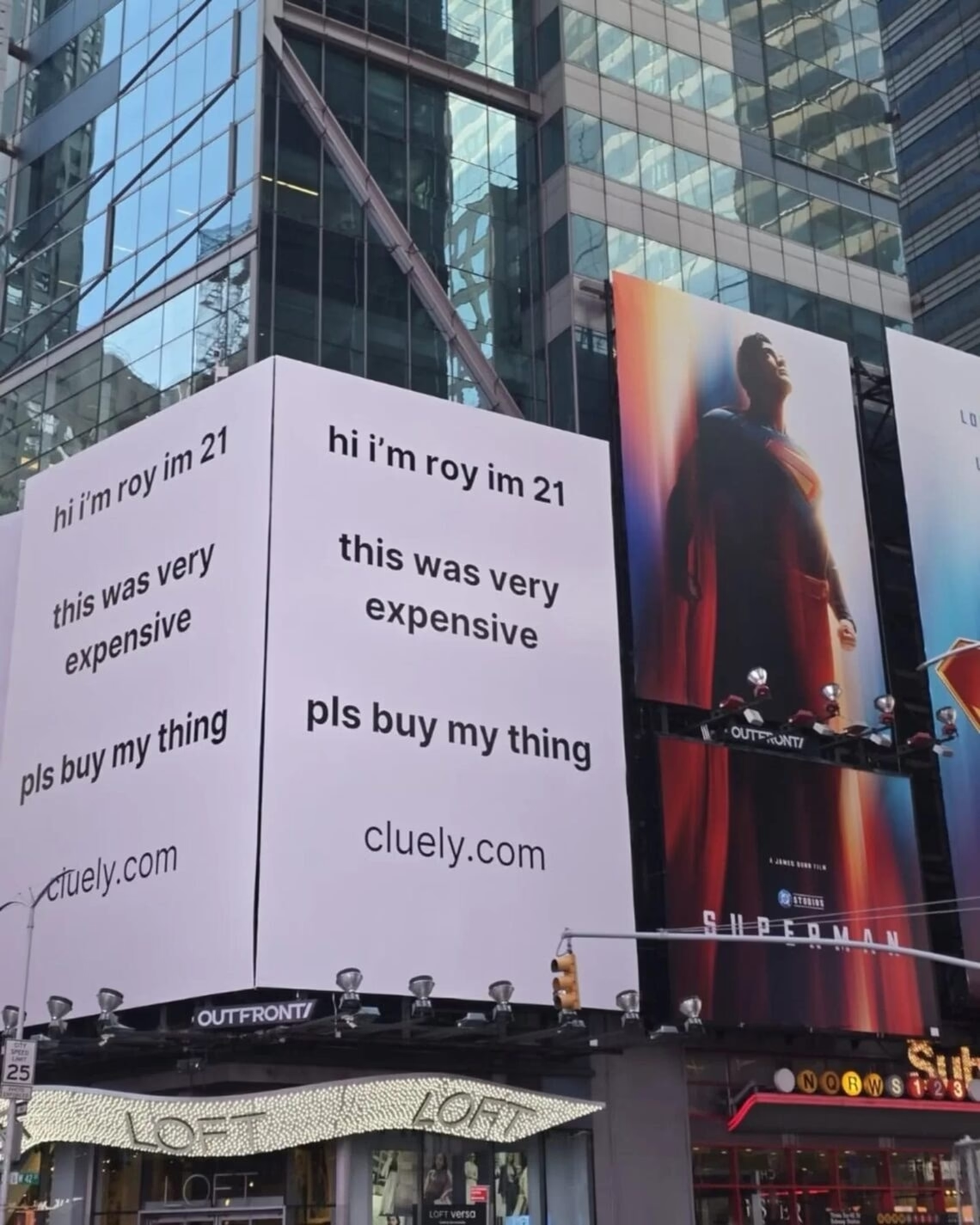
Writers are deliberately sabotaging their own work. Peppering in typos, commas in all the wrong places, and just sticking with simple, shoot from the hip, ideas and formats. Low effort is the new way to signal humanity.
And, for the most part, it really works. Who doesn’t feel a little serotonin dump when looking at this kind of billboard?

But this lo-fi aesthetic that signals organic creation is also very imitable. At best this anti-AI style is a temporary moat.
Sooner or later, AI will catch up to its own tells and offer a more ‘authentic’ alternative, and the trend for ‘bad’ writing will pass.
AI writing is unnaturally perfect, and there’s a notable absence of concrete details. It can’t create a human narrative that is full of seemingly unnecessary texture, uncertainty, and cringe. The most universal stories, after all, are told with the weirdest specificity (which is why, I hope, AI will never do a good job of writing a novel).
But just dropping to lowercase to signal a human hand has been in the mix isn’t enough. In fact, the biggest ‘tell’ that you’re a bag of flesh typing this might just be your voice, your singular self.
This isn’t just about your distinct rhythm and tone, it’s also about the unexpected connections and images that come from your brain alone. AI can deliver non-sequiturs, but they tend to be absent of deeper meaning and novel connection. They’re just weird.
It’s the nods and winks that AI fails to capture: it’s the experience you bring to the page. It’s the ability to be surprising or unexpected in a way that reveals real insight behind your ideas.
It’s the chinchilla, okay, it’s the chinchilla. And even in B2B – especially in B2B – you need the chinchilla.
Avoid the AI blandification in B2B
AI has literally been trained to be inoffensive and plausible. It nails corporate language and a streamlined aesthetic. But when our eyes glaze over at its blandification, it doesn’t exactly produce work that creates cut through.
Also, people are getting pretty good at spotting AI. You can even ask AI itself if what you’re reading is AI and it’ll give you a fair answer.
All of this is not to say that AI isn’t useful for many things, including ideation and structure. But underneath its sweet, shiny, saccharine wrapping, it has no authentic perspective.
Great people and great brands have a point of view. Even if the varnish on top of that point of view is glossy.
In the world of B2B, a little friction is never a bad thing. If you stand for nothing, you appeal to no one. You need to alienate the unready to galvanise the ready.
A point of view is how you find your audience. Even if some people don’t like it. Especially if some people don’t like it.
Rough edges and left turns in your writing are what make your readers’ brains do the work to understand what you’re signifying. And people like working stuff out. They like making connections and feeling clever. They like being in on the joke.
So let them.
At this point you might be wondering if I used AI to write this
I’m still writing in sentence case – are you worried yet? Probably not. So I don’t think you have to write crap to signal creative genius. After all, outsourcing writing is outsourcing thinking. In the same vein, lazy writing might also be lazy thinking.
You might be better off using your human brain to its real advantage. LLMs are prediction engines. They select the next most likely word in the chain.
But you can pull off unlikely connections between language and ideas that signal something truly intuitive and insightful. This can only come from a kind of social intelligence that a prediction engine doesn’t have, and it’s incredibly powerful.
It starts from sitting down and doing the work in full flow, rather than breaking your thought process by constant deference to your AI co-writer.
From here, you can find your magic moment: the articulation of a thought or idea that makes your brain light up like a fruit machine, that gets your heart beating faster and sends you forward in your chair.
It gets you to the thing that has emotional resonance. Because if it resonates with you, it’ll resonate with other people too. Even, or especially, if it’s obscure and esoteric.
If this feels like a struggle on a particular Thursday when the sky is grey and the air is full of water and no one really likes anybody, just remember that AI has access to the entire history of online creativity. It’s even trained itself on basically every novel ever written.
And yet, my friend, it can’t do what you can.
More of this in your inbox

Published in:
Subscribe to our updates.
Get fresh marketing insights rooted in customer science to help you stay ahead.
Relatedcontent

Everyone Sounds Certain Now. Who’s Actually Right? B2B Marketing in the Age of AI
AI makes B2B marketing sound certain. Pretzl CEO Greg Salmon explains why lead scores and attribution need testing and how evidence earns buyer confidence.Pretzl named a top global and US B2B agency by B2B Marketing
Pretzl named a top ten US and Global B2B Agency by B2B Marketing in two new 2026 benchmarking reports.